Copyright

(c) 2010-2026 Jon L Gelman, All Rights Reserved.

Tuesday, March 29, 2011

Symposium on Prevention of Occupationally-Related Distracted Driving

Distracted driving (including texting while driving and cell phone use) is a major cause of motor vehicle crashes. Many workers may be distracted while performing work-related driving or during vehicle operations. Reducing distracted work-related driving and increasing awareness of the risk to employees that result from distracted driving is an important mission for safety and health professionals, employers and employees. This Symposium is designed to bring together a variety of stakeholder groups who are interested in reducing work-related driving distractions and generate recommendations for action, including new directions for research. This Symposium will include didactic presentations, interactive discussions and opportunities for networking, and demonstrations of training materials.

Monday, April 18, 2011
8:30 AM - 4:00 PM

Kossiakoff Conference Center
11100 Johns Hopkins Road
Laurel, Maryland 20723
1-800-548-3647

8:30 - 9:00 am:
Registration and continental breakfast

9:00 - 9:15 am:
Welcome and Review of the Agenda
Mary Doyle, MPH,RN, COHN-S/CM
Director, ERC Continuing Education Program
Johns Hopkins Bloomberg School of Public Health
Meeting Moderator

9:15 - 9:30 am:
Mission of the Symposium and Call to Action
Christine Branche, PhD
Principal Associate Director
The National Institute for Occupational Safety and Health
Centers for Disease Control and Prevention

9:30 - 9:50 am:
U.S. DOT Perspective on Distracted Driving
Peter Appel
Administrator, Research and Innovative Technology Administration
Department of Transportation

9:50 - 10:10 am:
OSHA’s Perspective on Distracted Driving
David Michaels, PhD, MPH
Assistant Secretary of Labor for OSHA
Department of Labor

10:10 - 10:40 am:
What Does the Research Tell Us?
Jeffrey S. Hickman, PhD
Virginia Tech Transportation Institute
Center for Truck and Bus Safety
Virginia Polytechnic Institute and State University

10:40 - 11:00 am:
Audience Q & A/Feedback for morning sessions

11:00 – 11:15 am
Break and Networking

11:15 - 12:00 pm:
Panel Discussion: Elements of Model Programs: Implementation Challenges
Moderator: Jack Hanley
Executive Director
Network of Employers for Traffic Safety

Panelists:

Joseph Van Houten, PhD, CSP
Senior Director, Worldwide EHS
Johnson & Johnson

Tom Bennett
SH&E/OIMS Advisor, Fuels Marketing
Downstream & Chemical SSH&E

Amy Lokken, ARM
Group Director, North American Health & Safety
Coca-Cola Refreshments

David Hopps
Vice President, Risk Management Operations & Environment, Safety & Health
ServiceMaster

12:00 – 12:15 pm:
Audience Discussion and Feedback on Model Programs Panel

12:15 - 1:15 pm:
Lunch (provided on-site)

1:15 - 2:00 pm:
Panel Discussion: In-vehicle Technology to Address Distracted Driving
Moderator: Peter Appel
Administrator, Research and Innovative Technology Administration
Department of Transportation

Panelists:

Eric Collins, JD
Chief Operations Officer
Mobile Posse

Michael Petricone, JD
Senior VP, Government Affairs
Consumer Electronics Association

2:00 - 2:15 pm
Audience Discussion and Feedback on In-Vehicle Technology Panel

2:15 - 3:00 pm:
Panel Discussion: Worker Perspectives
Moderator: James August, MPH
Health and Safety Consultant

Panelists:

LaMont Byrd
Director, Safety and Health Department
International Brotherhood of Teamsters

Rich Duffy
Assistant to the General President for Occupational Health, Safety and Medicine
International Association of Fire Fighters – AFL/CIO

Ed Watt, MS
Director of Health and Safety
Transportation Workers Union of America

3:00 - 3:15 pm
Audience Discussion and Feedback on Workers’ Perspective Panel

3:15 - 3:45 pm:
Facilitated Discussion with Audience
Leslie Nickels, PhD, MEd
Senior Health Communications Fellow
National Institute for Occupational Safety and Health
Centers for Disease Control and Prevention

3:45 - 4:00 pm:
Closing
Mary Doyle, Meeting Moderator

4:00 - 5:00 pm: 
Reception (on site)

Monday, March 28, 2011

Colorado Court Allows RICO Case to Proceed Against Wal-Mart

A partial summary judgment motion was denied by Judge Robert E. Blackburn in a pending Colorado case against Wal-Mart where the plaintiff alleged that the employer,  working in concert with other defendants "dictated and interfered unlawfully " with employees who were entitle to medical treatment flowing from occupational accidents. 

The Court stated that, "The plaintiffs allege that the defendants improperly required, and continue to require, treatment providers to follow protocol notes that improperly direct and/or restrict the medical treatment provided to injured Wal-Mart workers under the Act. The plaintiffs allege that the policies implemented by the defendants result in delays in the injured workers' receipt of treatment, denial of prescribed medical treatment, withholding of benefits, and/or the inability of the injured workers to obtain prescribed medical treatment."

The case involves a certified class of plaintiffs. The defendants had sought to limit the number of claimants by shortening the statute of limitations for the viability of the claims under the Racketeer Influenced and Corrupt Organizations Act (RICO), 18 U.S.C. § 1961-1968. Since the relevant time periods were not evident on the face of the complaint, and the defendants did not offer proof to establish it, the Court denied the motion.

Gianzero v. Wal-Mart Stores Inc., 2011 WL 1085647 (D. Colo. 2011) Decided March 24, 2011.


US Detects Low Levels of Radioactivity in Eastern States


The Federal government has established a plan to monitor radiation from the failing Japanese nuclear reactor and initially respond to increased radiation levels. An official health advisory has been issued by the US Centers for Disease Control (CDC) through its Health Alert Network (HAN).

"As a result of the incident with the Fukushima nuclear plant in Japan, highly sensitive radiation monitors operated by EPA and others are detecting very low levels of radioactive material in the air in the United States. These levels were expected and consistent with estimated releases from the damaged nuclear reactors and are far below levels of public health concern.
"Elevated levels of radioactive material in rainwater have also been expected as a result of the nuclear incident after the events in Japan, since radiation is known to travel in the atmosphere. There have been reports received that several states including Pennsylvania and Massachusetts have detected elevated levels of radiation in rainwater following recent precipitation events."

As a result of the incident with the Fukushima nuclear plant in Japan, several EPA monitors have detected very low levels of radioactive material in the United States consistent with estimates from the damaged nuclear reactors. These detections were expected and the levels detected are far below levels of public-health concern.

Elevated levels of radioactive material in rainwater have been expected as a result of the nuclear incident after the events in Japan since radiation is known to travel in the atmosphere. There have been reports received that the states of Pennsylvania and Massachusetts have seen elevated levels of radiation in recent precipitation events. EPA is reviewing this data – however, in both cases these are levels above the normal background levels historically reported in these areas.

While short-term elevations such as these do not raise health concerns – and the levels seen in rainwater are expected to be relatively short in duration – the U.S. EPA has taken steps to increase the level of nationwide monitoring of precipitation, drinking water, and other potential exposure routes to continue to verify that. EPA’s only recommendation to state and local governments is to continue to coordinate closely with EPA, CDC and FDA – EPA will continue to communicate our nationwide sampling results as they come in.

In addition to air quality issues, the Federal government is monitoring food safety, and ships and cargo from Japan. The US Centers for Disease Control (CDC) issued a recommendation at this time not to take potassium Iodine (KI) supplements in response to the damaged nuclear reactors in Japan unless advised by your physician, emergency management officials, or public health officials.

Saturday, March 26, 2011

Occupational Chemical Exposures Continue to Take an Enormous on Human Life

Chemical exposures continue to impact health and result in an enormous burden on human life. Over 4.9 million deaths world-wide and 86 million Disability-Adjusted Life Years were attributed to environmental exposure and the management of chemicals.

See: Knowns and unknowns on burden of disease due to chemicals: a systematic review Environmental Health 2011, 10:9 doi:10.1186/1476-069X-10-9

Friday, March 25, 2011

Grizzly Bear Attack Does Not Deter Benefits Even Though Employee Was Using Marjuana

The Montana Supreme Court ordered the Uninsured Fund to pay workers' compensation benefits to an employee who was mauled by an grizzly bear even, though the worker was under the influence of marijuana at the time of the accident.

The Court held that the marjuana was not a major contributing cause of the employee's injuries.

"Non-prescription drug consumption will preclude an injured employee’s benefits if consumption was the leading cause contributing to the result, when compared to all othersSection 39-71-407(4), and -407(13), MCA. No evidence was presented regarding Hopkins’ level of impairment. The WCC [Workers' Compensation Court] aptly noted, “Hopkins’ use of marijuana to kick off a day of working around grizzly bears was ill-advised to say the least and mind-bogglingly stupid to say the most.” However, the WCC further noted that grizzlies are “equal opportunity maulers,” without regard to marijuana consumption. Without evidence of Hopkins’ level of impairment, the WCC correctly concluded that marijuana was not the major contributing cause of Hopkins’ injuries."

The majority of states permit the payment of workers' compensation benefits where the use  was not the sole cause of the accident. Usually Uninsured Funds are able to obtain reimbursement directly for the employer who failed to carry workers' compensation benefits.

Hopkins v. Uninsured Employers Fund, et al., Docket 2011 MT 49 (MT 2011) Decided March 22, 2011

Thursday, March 24, 2011

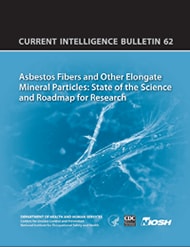
NIOSH Issues "Roadmap" Document Suggesting Asbestos Research Strategy


The National Institute for Occupational Safety and Health (NIOSH) announces the availability of “Current Intelligence Bulletin: Asbestos Fibers and Other Elongate Mineral Particles: State of the Science and Roadmap for Research.” The document contains NIOSH’s recommended framework for a national research strategy to address current scientific uncertainties about occupational exposure and toxicity issues relating to asbestos fibers and other elongate mineral particles.
The Current Intelligence Bulletin is available online at www.cdc.gov/niosh/docs/2011-159/.
It is well documented that asbestos fibers can cause lung cancer and other types of serious lung disease in workers when inhaled. Since the passage of the Occupational Safety and Health Act in 1970, considerable progress has been made in preventing harmful exposures and protecting workers from risks of illness. However, many scientific uncertainties remain as to the health risks associated with exposure to other elongate mineral particles, including those with mineralogical compositions identical or similar to the asbestos minerals and those that have already been documented to cause asbestos-like disease, as well as the physical and chemical characteristics that determine toxicity.
The new NIOSH document incorporates extensive public comment and scientific peer review, including review by an independent committee of the Institute of Medicine and the National Research Council. The document does not set any new NIOSH policy regarding asbestos fibers and other elongate mineral particles.
“The NIOSH roadmap outlines a strategic framework for designing, conducting, and applying the research that will best serve the need to address persistent scientific uncertainties about occupational health and elongate mineral particles,” said NIOSH Director John Howard, M.D. “We look forward to working with our partners to advance this research, building on today’s state-of-the-art scientific tools and methodologies.”
Priority areas for research, as proposed by the roadmap, include:
  • Developing a broader understanding of the factors that determine the toxicity of asbestos fibers and other elongate mineral particles.
  • Developing information and knowledge on occupational exposures to asbestos fibers and other elongate mineral particles, and related health outcomes.
  • Development of improved sampling and analytical methods for asbestos fibers and other elongate mineral particles.
  • Applying research outcomes to improve public policy.
NIOSH is the federal agency that conducts research and makes recommendations for preventing work-related injury, illness, and death. NIOSH has a longstanding program of research and health surveillance to prevent asbestos-related disease, and its scientific findings and recommendations have contributed significantly to national policies for eliminating or minimizing harmful exposures. Further information is available at www.cdc.gov/niosh/topics/asbestos/.
For over 3 decades the Law Offices of Jon L. Gelman  1.973.696.7900  jon@gelmans.com have been representing injured workers and their families who have suffered asbestos related disease.

MIssouri Mulls More Work Comp Reform

Guest Blog by B. Michael Korte


The Missouri legislature is again considering a number of proposals to change its workers’ compensation system. Every year brings various efforts to continue to ratchet down the benefits provided to injured workers, but this year is the first since 2005 that any change is expected. That year, extensive changes were passed, including a requirement that cases be construed "strictly" rather than liberally. 

Strict construction has proven to be a two-edged sword, with courts recently strictly construing Missouri law to allow more civil lawsuits against fellow employees, and perhaps excluding occupational diseases from the workers’ compensation system and allowing them to proceed in the civil court system. 

Legislation will almost certainly pass in the pro-business-dominated legislature to close these loopholes. What remains to be seen is whether the legislature will finally act to save the state’s second injury fund

The 2005 legislation placed a hard cap on funding for the fund, which has left it nearly bankrupt. The fund stopped making settlement offers in 2009, but now is finding itself unable to pay arrearages on permanent total disability awards. Although numerous independent audits agree that lifting the cap would solve the problem, legislative proposals are focusing instead on limiting or eliminating the fund.

The legislature will have until its adjournment on May 13 to solve the problem, but will also be consumed with budgetary and other problems in the meantime.

B. Michael Korte practices in Kirkwood, Missouri (The Korte Law Firm). B. Michael Korte is the author of Missouri Practice Vol. 29, Workers Compensation Law and Practice. He previously served as president of the Missouri Association of Trial Attorneys, and  has been awarded its Outstanding Service Award. He previously served as president of the Missouri Association of Trial Attorneys, and has been awarded its Outstanding Service Award. He frequently lectures statewide at seminars sponsored by the Missouri Division of Workers’ Compensation, bar associations, and other groups. He has served as the chair of the Missouri Bar Association Workers’ Compensation Committee and as President of Kids’ Chance, Inc., a workers compensation charity.

Related articles