Copyright

(c) 2010-2026 Jon L Gelman, All Rights Reserved.

Monday, January 4, 2010

Gelman to Speak on Employment Discrimination Claims


Jon L. Gelman will join a distinguished to panel of attorneys to discuss employment discrimination claims. The  seminar to be presented by the NJ Institute for Continuing Education  will be moderated by David H. Ben-Asher.

Tuesday, March 16, 2010
4:00 PM to 7:30 PM

As the practice of employment law in New Jersey becomes increasingly complex, other legal fields sometimes intersect with that practice in significant ways. In order to effectively represent clients in discrimination, whistleblower retaliation, contract and similar matters, employment lawyers must have a basic understanding as to the potential influence of legal principles and remedies in fields such as criminal, tax, insurance, labor-management, workers’ compensation, bankruptcy and disability benefits law. A panel of practitioners experienced in those areas will limit their discussion to substantive and practical ways in which their fields affect the handling of employment matters
Labor-Management - Peter L. Frattarelli, Esq. 
How unionized employees’ collective bargaining agreement grievances and arbitration, N.L.R.B. charges and duty of fair representation suits bear upon their discrimination, whistleblower and other employment law claims.
Workers’ Compensation - Jon L. Gelman, Esq. 
When and how compensation claims should be pursued. The synergy between workers’ compensation claims and employment civil actions and their relation to liens and setoffs. Provisions regarding workers’ compensation in settlement and release agreements
Criminal Law - Bruce I. Goldstein, Esq. 
Issues of potential criminal exposure of employees and employers in whistleblower retaliation and other employment matters. Addressing the criminal legal questions which may arise during the conduct of corporate internal investigations. How the rights of the corporation and its employees are vindicated during governmental investigations.
Bankruptcy - Gerald H. Gline, Esq. 
The treatment in bankruptcy of employment contracts and benefits, non-competition agreements and settlements. Handling employment claims against employers which are in bankruptcy or claims by employees who have filed for bankruptcy. When and how employment claims need to be proven in Bankruptcy Court. Collecting employment damage awards when the employer has been discharged in bankruptcy.
Insurance - Barbara A. O’Connell, Esq.
 Types of insurance policies that can provide coverage in an employment case. Coverage and bad faith litigation. Workers’ compensation policies and situations which give rise to the obligation thereunder to pay for the defense and pain and suffering damages in employment cases. Employment Practices Liability Insurance: dealing with deductibles, punitive damage claims, settlements and the selection of defense counsel.
Tax - Sean M. Aylward, Esq.
 Tax considerations in the handling of employment cases and in the negotiation, structuring and tax reporting of settlements. How Internal Revenue Code Section 409A applies to deferred payments.
Disability Benefits - Bonny G. Rafel, Esq. 
Availability and pursuit of short term and long term disability insurance benefits. Definitions of residual disability, pre-disability income and occupation. Provisions related to disability buyout and overhead expense coverage. Pitfalls resulting from severance agreements. The interaction between employees’ claims for disability benefits and their employment law claims and damages, including issues of liens, setoffs and judicial estoppel.

Driving While Distracted Compared to a DUI


A growing momentum is now taking hold that is comparing driving while distracted (DWD) to driving under the influence (DUI). Over 200 pieces of legislation have now been offered nation wide to prohibit such activities.

“People are starting to see it like drunk driving, and that’s the comparison we need to continue to make,” said Steve Farley, an Arizona state representative. The next step will be a determination whether State workers’ compensation law will consider the activity outside the course of employment or mandated by statute as  exclusion from coverage.

The NY Times has reports that 22% of all drivers talk of their phone while driving and DWD accounts for 2,600 deaths per year and 570,000 injuries.

Sunday, January 3, 2010

OSHA Moving to Finalize Crystalline Silica Exposure Standard

The Occupational Safety and Health Administration (OSHA) is moving forward on implementing the standard for occupational exposure to silica. Silica has long been considered an occupational hazard. 


Silicosis was one of the enumerated occupational diseases that were universally included into workers' compensation statutes about 40 years after the enactment of the initial model acts were adopted, at the behest of Industry, to avoid civil liability actions. Occupational disease claims continue to be problematic for State compensation systems.


"Crystalline silica is a significant component of the earth's crust, and many workers in a wide range of industries are exposed to it, usually in the form of respirable quartz or, less frequently, cristobalite. Chronic silicosis is a uniquely occupational disease resulting from exposure of employees over long periods of time (10 years or more). Exposure to high levels of respirable crystalline silica causes acute or accelerated forms of silicosis that are ultimately fatal. The current OSHA permissible exposure limit (PEL) for general industry is based on a formula recommended by the American Conference of Governmental Industrial Hygienists (ACGIH) in 1971 (PEL=10mg/cubic meter/(% silica + 2), as respirable dust). The current PEL for construction and maritime (derived from ACGIH's 1962 Threshold Limit Value) is based on particle counting technology, which is considered obsolete. NIOSH and ACGIH recommend 50µg/m3 and 25µg/m3 exposure limits, respectively, for respirable crystalline silica. Both industry and worker groups have recognized that a comprehensive standard for crystalline silica is needed to provide for exposure monitoring, medical surveillance, and worker training. The American Society for Testing and Materials (ASTM) has published a recommended standard for addressing the hazards of crystalline silica. The Building Construction Trades Department of the AFL-CIO has also developed a recommended comprehensive program standard. These standards include provisions for methods of compliance, exposure monitoring, training, and medical surveillance. "


It is anticipated that the Peer Review phase will be completed in January 2010 and that NPRM (Notice of Proposed Rulemaking ) will be completed in July 2010.


The proposed Rules, 29 CFR 1915; 29 CFR 1917; 29 CFR 1918; 29 CFR 1926 (To search for a specific CFR, visit the Code of Federal Regulations.


Friday, January 1, 2010

Older Energy Workers Occupationally Ill

A new study reveals that older energy workers suffer a propensity of occupational illnesses. Historically occupational diseases of energy workers were primarily associated with limited radioactive substances.


"The age-standardized prevalence ratio of COPD among DOE workers compared to all NHANES III data was 1.3. Internal analyses found the odds ratio of COPD to range from 1.6 to 3.1 by trade after adjustment for age, race, sex, smoking, and duration of DOE employment. Statistically significant associations were observed for COPD and exposures to asbestos, silica, welding, cement dusts, and some tasks associated with exposures to paints, solvents, and removal of paints."


Click here to read more about energy workers and workers' compensation.

Thursday, December 24, 2009

NJ Aims to Speed up Uninsured Penalties

The NJ Legislature is considering speeding up the processing of penalties and assessments against uninsured employers. Bills are pending before both houses of the legislature.


"This bill amends the workers’ compensation law to require that the Director of Workers’ Compensation shall, in any case in which an award of compensation payable by an uninsured employer or an assessment has been ordered by the director, file with the Clerk of the Superior Court a statement of the findings and judgment of the workers’ compensation judge or a certified copy of the director's order.  Upon that filing, the statement or order, as the case may be, shall have the same effect and may be collected and docketed in the same manner as judgments rendered in causes tried in the Superior Court.


"Under current law, the director is not permitted to make the filing until 45 days after payment is due and 10 days after the uninsured employer fails to comply with any demand to deposit with the director the estimated value of the compensation, and 20 days after orders by the director to pay any assessments for failure to pay.  The bill requires, rather than permits, the director to make the filing, and requires that the filing be made without the delays currently imposed.


Identical Bill Number: S2495   

Quijano, Annette   as Primary Sponsor
Barnes, Peter J., III   as Primary Sponsor
Moriarty, Paul D.   as Primary Sponsor
Egan, Joseph V.   as Co-Sponsor
Diegnan, Patrick J., Jr.   as Co-Sponsor
Vas, Joseph   as Co-Sponsor


1/15/2009 Introduced, Referred to Assembly Labor Committee
1/26/2009 Reported out of Assembly Committee, 2nd Reading
5/21/2009 Passed by the Assembly (76-0-0)
5/21/2009 Received in the Senate without Reference, 2nd Reading

Statement - ALA 1/26/09 - 1 pages
PDF Format    HTML Format
Introduced - 3 pages
PDF Format    HTML Format


Committee Voting:
ALA  1/26/2009  -  r/favorably  -  Yes {9}  No {0}  Not Voting {0}  Abstains {0}  -  
Roll Call

Session Voting:
Asm.  5/21/2009  -  3RDG FINAL PASSAGE   -  Yes {76}  No {0}  Not Voting {4}  Abstains {0}  -  
Roll Call

.........
Click here to read more about uninsured  employers and workers' compensation.

Monday, December 21, 2009

Good Medicine for an Ailing Compensation System


An historic shift in the delivery of medical care for those injured by occupational exposures has been signaled by the US Senate. Following decades of debate, the proposed emerging health care legislation, amended at the last minute by the Majority Leader's manager amendments, shifts Libby, Montana's asbestos disease claims to Medicare as a primary payor.

The stage was set last June 17th, when the US Environmental Protection Agency (EPA) declared Libby, Montana, a Public Health  Emergency, because of asbestos present at the site. The geographical location was the site of a W.R. Grace vermiculite mine.

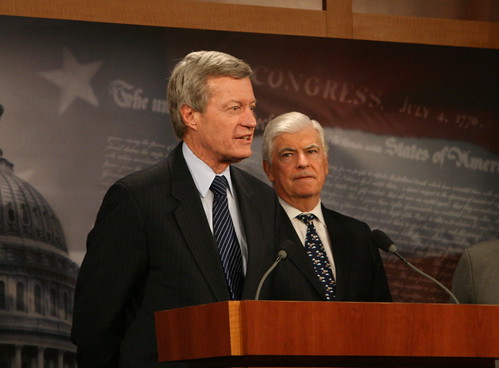
The legislative provision was "buried" deep in the legislation at the last moment, reported Robert Pear of the NY Times. The amendment was made Senator Max Baucus of Montana, who lead the Senate legislative committee crafting the legislation. The convoluted political bartering over the last few days reflects a sentinel change in how injured workers may be receiving medical care in the years ahead. It is anticipated that major changes will be offered over the years ahead to modify and expand the coverage.

Occupational diseases have always been problematic to the State workers' compensation systems. They have been subject to serious and costly proof issues. They were "tag along" claims for a compensation system that initially was enacted in 1911 to cover only traumatic claims. The proposed legislation is a first major step to move occupationally induced illnesses into a universal health medical care system and will provide a pilot project for addressing the long awaited need to furnish medical care without serious and costly delays.

By allowing Medicare to become the primary payor and furnish medical care, those without a collateral safety net of insurance will be able to obtain medical care effectively and expeditiously. While cost shifting from workers' compensation to Medicare has been an historically systemic problem in the compensation arena, this legislation maybe a first major step to legitimatize the process. The legislation may allow for great accountability and expansion of the Medicare Secondary Payment Act (MSP) to end cost shifting that has become epidemic in proportion. It is good medicine for an ailing workers' compensation system.


Click here to read more about workers' compensation and universal health care.

Sunday, December 20, 2009

Join Us on Facebook: Injured Workers Law & Advocacy Group


The Injured Workers Law & Advocacy Group is an open and free Facebook group that provides news and open discussions concerning national workers' compensation trends. 
The group is maintained for academic purposes to facilitate national policy discussions. Multiple news feeds and discussion postings are available free of charge.
Click here to join now.