Click here to read more about David Michaels and OSHA.
Copyright
(c) 2010-2026 Jon L Gelman, All Rights Reserved.
Sunday, December 6, 2009
David Michaels Confirmed by US Senate to Head OSHA
Click here to read more about David Michaels and OSHA.
Saturday, December 5, 2009
Workplace Safety, the Aging Workforce & The Logical Step
Safety in the workplace is now a growing concern as US aging workforce expands. It has been frequently reported that the expansion of this dimension of the labor sector has generated an increase in serious accidents and illness at work.
Over the past decade the work force has demographically changed. The number of those who are working past age 55 has grown. This increase mirrors an increase in accidents at work. It well known that those age 55 and older have a higher propensity for illness and disease resulting in complex of medical conditions.
The workers' compensation claims for this age group have become more serious and eventually evolve into Social Security Disability Claims. Besides the administrative complexity of navigating a fragile and dysfunction workers' compensation, these workers are require more emergent medical care for exigent conditions.
The National Institute for Occupational Safety and Health (NIOSH) has recognized this issue and is attempting to put SAFETY back into the equation.
"A report of conference presentations and discussions among participants from the National Academies of Science, universities and research institutions, and representatives of professional associations, industry and labor, recommends attention to workplace environments to maintain “work ability” as workers age, along with legislative fixes and research to fill in knowledge gaps for keeping workers healthy and productive."
As Social Security studies these issues, and more reliable data becomes available through NIOSH's efforts, a redesign of the approach to mandate safety, and deliver medical benefits universally and in a more efficient fashion, appears to be the next logical step.
Click here to read more about safety and workers' compensation.
Over the past decade the work force has demographically changed. The number of those who are working past age 55 has grown. This increase mirrors an increase in accidents at work. It well known that those age 55 and older have a higher propensity for illness and disease resulting in complex of medical conditions.
The workers' compensation claims for this age group have become more serious and eventually evolve into Social Security Disability Claims. Besides the administrative complexity of navigating a fragile and dysfunction workers' compensation, these workers are require more emergent medical care for exigent conditions.
The National Institute for Occupational Safety and Health (NIOSH) has recognized this issue and is attempting to put SAFETY back into the equation.
"A report of conference presentations and discussions among participants from the National Academies of Science, universities and research institutions, and representatives of professional associations, industry and labor, recommends attention to workplace environments to maintain “work ability” as workers age, along with legislative fixes and research to fill in knowledge gaps for keeping workers healthy and productive."
As Social Security studies these issues, and more reliable data becomes available through NIOSH's efforts, a redesign of the approach to mandate safety, and deliver medical benefits universally and in a more efficient fashion, appears to be the next logical step.
Click here to read more about safety and workers' compensation.
Friday, December 4, 2009
US Supreme Court About to Rule on RICO Case
The US Supreme Court has placed Cassens Transport Co., et al., Petitioners v, Paul Brown, et al., No. 08-1375 on its conference agenda for December 4, 2009. At that time the Justices will review the Petition for Certiorari.
Pending before the US Supreme Court is a petition for a writ of certiorari to review a decision where: the employer, insurance company and their experts were found to have conducted themselves in violation of the RICO Act.
In this reverse preemption case, Public Citizen filed a brief which crystallizes the issues before the Court.
Deepak Gupta and Allison Zieve of Public Citizen are co-counsel for the respondent.
"Respondent’s Brief in Opposition to the Petition for Certiorari.
The McCarran-Ferguson Act, 15 U.S.C. § 1012(b), “precludes application of a federal statute” that would “invalidate, impair, or supersede” a state law “enacted * * * for the purpose of regulating the business of insurance.” The questions presented in this case are:
1. Whether a state workers’ compensation law that transfers the risk of workplace injuries to employers, and requires that employers secure their ability to assume those risks either by purchasing of insurance or by self insuring, regulates the “business of insurance” within the meaning of the McCarran-Ferguson Act.
2. Whether a State’s exclusive, administrative remedial scheme for handling contested workers’ compensation benefit determinations is impaired within the meaning of the McCarran-Ferguson Act by the availability of suits under the federal Racketeer Influenced and Corrupt Organizations Act, 18 U.S.C. § 1961 et seq., contesting the denial of worker’s compensation claims."
Click here to see the Workers' Compensation Blog for additional articles on RICO matters and workers' compensation.
Pending before the US Supreme Court is a petition for a writ of certiorari to review a decision where: the employer, insurance company and their experts were found to have conducted themselves in violation of the RICO Act.
In this reverse preemption case, Public Citizen filed a brief which crystallizes the issues before the Court.
Deepak Gupta and Allison Zieve of Public Citizen are co-counsel for the respondent.
"Respondent’s Brief in Opposition to the Petition for Certiorari.
The McCarran-Ferguson Act, 15 U.S.C. § 1012(b), “precludes application of a federal statute” that would “invalidate, impair, or supersede” a state law “enacted * * * for the purpose of regulating the business of insurance.” The questions presented in this case are:
1. Whether a state workers’ compensation law that transfers the risk of workplace injuries to employers, and requires that employers secure their ability to assume those risks either by purchasing of insurance or by self insuring, regulates the “business of insurance” within the meaning of the McCarran-Ferguson Act.
2. Whether a State’s exclusive, administrative remedial scheme for handling contested workers’ compensation benefit determinations is impaired within the meaning of the McCarran-Ferguson Act by the availability of suits under the federal Racketeer Influenced and Corrupt Organizations Act, 18 U.S.C. § 1961 et seq., contesting the denial of worker’s compensation claims."
Click here to see the Workers' Compensation Blog for additional articles on RICO matters and workers' compensation.
Tuesday, December 1, 2009
AIG Declines on Questionable Workers Compensation Reserves
A CNBC analyst has estimated that AIG's workers' compensation reserves may fall short this year contributing to an $11 Billion loss for the company. Shares of AIG were down 12% on the news of the possible deficiet.
To read more about AIG and workers' compensation click here.
The Gift That Keeps Giving: The SSA Reverse Offset
Social Security (SSA) has been subsidizing a select group of States since 1981. The workers' compensation insurance carriers in only those select States are permitted to take a credit against SSA payments.
The US Congress legislated that if a State had a recognized Social Security Offset Plan in effect on February 18, 1981, then the SSA would not offset workers' compensation benefits to those injured workers. In those jurisdictions, the offset is taken by the workers' compensation insurance carrier, who gains the advantage.
It was recently estimated that that over 583,923 individuals were receiving Social Security Disability Benefits. Of those, 156,096 were eligible for an offset to be taken by SSA. But, of those, 44,748 or 28.7%, were eligible for a reverse offset to be taken instead by the workers' compensation insurance companies.
To read more about Social Security and workers' compensation click here.
Those States that have been designated as "reverse offset"States, and are permitted have the workers' compensation carrier to take the credit are: California, Colorado, Florida, Louisiana, Minnesota, Montana, Nevada, New Jersey, New York, North Dakota, Ohio, Oregon, Washington and Wisconsin.
The US Congress legislated that if a State had a recognized Social Security Offset Plan in effect on February 18, 1981, then the SSA would not offset workers' compensation benefits to those injured workers. In those jurisdictions, the offset is taken by the workers' compensation insurance carrier, who gains the advantage.
It was recently estimated that that over 583,923 individuals were receiving Social Security Disability Benefits. Of those, 156,096 were eligible for an offset to be taken by SSA. But, of those, 44,748 or 28.7%, were eligible for a reverse offset to be taken instead by the workers' compensation insurance companies.
To read more about Social Security and workers' compensation click here.
Those States that have been designated as "reverse offset"States, and are permitted have the workers' compensation carrier to take the credit are: California, Colorado, Florida, Louisiana, Minnesota, Montana, Nevada, New Jersey, New York, North Dakota, Ohio, Oregon, Washington and Wisconsin.
Friday, November 27, 2009
Social Security's Inconsistencies
The News Journal of Delaware has reported broad statistical inconsistencies in the Social security claims determination process. In an 11 part series entitled, "Shut Out of Social Security," the paper analyzed statistical data from all states, hearing office and administrative law judges revealing variances in percentages of workloads and denial rates for disability benefits.
To read more about Social Security and productivity reports click here.
OSHA Sets H1N1 Flu Employer Responsibility Standard for Health Care Workers
The U.S. Department of Labor's Occupational Safety and Health Administration (OSHA) has issued a compliance directive that clearly establishes a level of employer responsibility to health care workers to prevent the spread of H1N1 flu. The establishment of the standard may allow some injured workers to circumvent "the exclusivity doctrine" in workers' compensation and hold employers responsible in the civil justice system for resultant injury or death should the employer's fail to comply with is directive.
The "exclusivity doctrine" in workers' compensation limits an employers' responsibility to only scheduled workers' compensation benefits for harm caused to workers that "arises out of" and occurs "within the course of employment." Those benefits have become increasingly difficult to obtain for a multitude of reasons.
The OSGA directive closely follows the prevention guidance issue by The Centers for Disease Control (CDC) to prevent the spread of H1N1 flu. The purpose of the compliance directive is "to ensure uniform procedures when conducting inspections to identify and minimize or eliminate high to very high risk occupational exposures to the 2009 H1N1 influenza A virus."
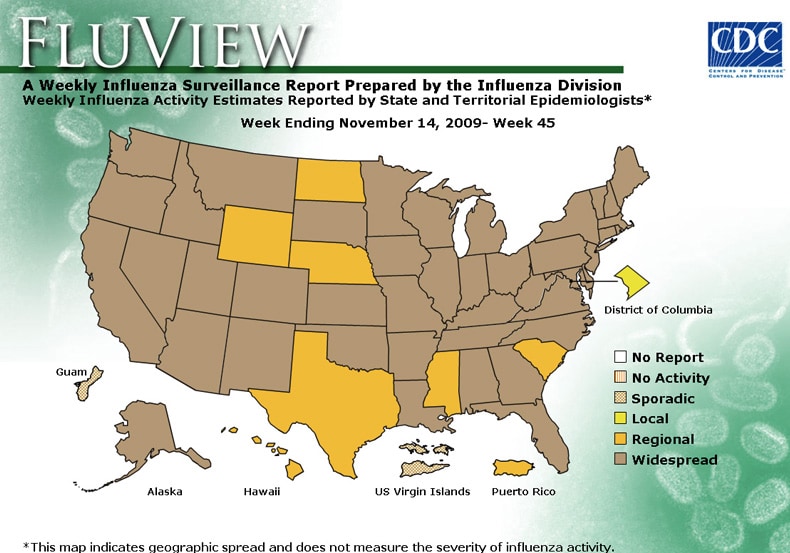
The CDC has reported that the H1N1 flu activity continues to be widespread in the US and remains above epidemic in proportion for the seventh consecutive week. Over 99% of all subtyped A viruses being reported to the CDC were 2009 influenza A (H1N1) viruses. A total of 171 deaths in children associated with the 2009 influenza A (H1N1) virus infection have been reported to the CDC.
OSHA announced, "In response to complaints, OSHA inspectors will ensure that health care employers implement a hierarchy of controls, and encourage vaccination and other work practices recommended by the CDC. Where respirators are required to be used, the OSHA Respiratory Protection standard must be followed, including worker training and fit testing. The directive also applies to institutional settings where some workers may have similar exposures, such as schools and correctional facilities."
"OSHA has a responsibility to ensure that the more than nine million frontline health care workers in the United States are protected to the extent possible against exposure to the virus," said acting Assistant Secretary of Labor for OSHA Jordan Barab. "OSHA will ensure health care employers use proper controls to protect all workers, particularly those who are at high or very high risk of exposure."
To read more about workers' compensation and the H1N1 Flu click here.
The "exclusivity doctrine" in workers' compensation limits an employers' responsibility to only scheduled workers' compensation benefits for harm caused to workers that "arises out of" and occurs "within the course of employment." Those benefits have become increasingly difficult to obtain for a multitude of reasons.
The OSGA directive closely follows the prevention guidance issue by The Centers for Disease Control (CDC) to prevent the spread of H1N1 flu. The purpose of the compliance directive is "to ensure uniform procedures when conducting inspections to identify and minimize or eliminate high to very high risk occupational exposures to the 2009 H1N1 influenza A virus."
The CDC has reported that the H1N1 flu activity continues to be widespread in the US and remains above epidemic in proportion for the seventh consecutive week. Over 99% of all subtyped A viruses being reported to the CDC were 2009 influenza A (H1N1) viruses. A total of 171 deaths in children associated with the 2009 influenza A (H1N1) virus infection have been reported to the CDC.
OSHA announced, "In response to complaints, OSHA inspectors will ensure that health care employers implement a hierarchy of controls, and encourage vaccination and other work practices recommended by the CDC. Where respirators are required to be used, the OSHA Respiratory Protection standard must be followed, including worker training and fit testing. The directive also applies to institutional settings where some workers may have similar exposures, such as schools and correctional facilities."
"OSHA has a responsibility to ensure that the more than nine million frontline health care workers in the United States are protected to the extent possible against exposure to the virus," said acting Assistant Secretary of Labor for OSHA Jordan Barab. "OSHA will ensure health care employers use proper controls to protect all workers, particularly those who are at high or very high risk of exposure."
To read more about workers' compensation and the H1N1 Flu click here.
Subscribe to:
Posts (Atom)