The RAND Corporation published yet another report evaluating the troubled California workers' compensation system. The report, in its esoteric evaluation, reflects on the poor financial judgment of the industry to meet the needs of the injured workers.
The study misses the focus and humanization of what workers' compensation is all about. The concept of providing a remedial and expeditious remedy to injured workers seems to have been left outside in the company parking lot.
The California problems are not isolated, they are nationally systemic. The system fails to deliver and fails to encourage a safer worker environment. More of the same old thing, as RAND recommends, ie. more business should be covered, and more premiums should be collected, just isn't going to cut it any longer.
Workers' compensation is fine, as long as a worker doesn't get sick. Dormant and latent conditions for the most part remain untreated by the present system. Preventive medical care is non-existent. Medical monitoring is a major struggle to secure.
Occupational disease cases have perpetually lingered through delay and denial tactics, and now the condition needs critical care that a bandaid will not cure. As the NY Times reports in results of a recent poll, the safety net has failed.
Nationally the system needs to re-worked. Injured workers need to receive medical care through an effective and efficient process and not left out in the streets to suffer. Congress needs to act to provide coverage through an expansion of the proposed national health care agenda.
Click here to read more about medical benefits and workers' compensation.
Copyright
(c) 2010-2026 Jon L Gelman, All Rights Reserved.
Tuesday, December 15, 2009
Genetics and Workers' Compensation Claims
Genetic predisposition to occupational illness and disease presents a complex issue in workers’ compensation claims and health technology assessment. New methods now permit the identification of individuals who have risk factors establishing a greater propensity for disabling medical conditions.
The challenge of how to use this evidence in the workplace, to create both a safer work environment, while maintaining the privacy of the existence of the workers’ genetic propensity is an on going challenge. Additionally, genetic evidence becomes increasingly important to establish pre-existing and co-existing medical conditions that might reduce or bar recovery in claims for benefits under workers’ compensation acts.
Testimony offered at trial has effective defeated claims. Evidence has been effective presented to defeat occupational claims, A defense expert testified,"....that studies show almost conclusively that no occupation causes a degenerative disc. It's familial. It's genetic. It has to do with how the DNA forms the disc in embryonic development.’” Allgood v. Parsons Trucking Co., 148 N. C.App. 405 (N.C.App. (2002).
A delicate balance exists between, the ethical, moral and legal use of this evidence. The appropriate use of this information by an employers in assessing risks and benefits in the workplace is challenging. Many tasks at work now include risk factors of a carcinogenic, mutagenic, and/or genotoxic nature.
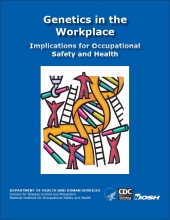
NIOSH ‘s recently published report, Genetics in the Workplace: Implications for Occupational Safety and Health, addresses balancing some of aspects of these issues while focussing on the paramount issue of safety in the workplace. “The use of genetic information in occupational safety and health research requires careful attention because of the real or perceived opportunities for the misuse of genetic information. Society in general and workers in particular have concerns that discrimination and lack of opportunity will result from the inappropriate use of genetic information [MacDonald and Williams-Jones 2002; Maltby 2000]. While only sparse or anecdotal information supports this contention, a wide range of workers, legislators, scientists, and public health researchers have concern that such discrimination could occur. Thus, GINA and other regulations were passed to prevent the potential misuse and abuse of genetic information in the workplace. Examples of safeguards include rules and practices for maintaining privacy and confidentiality, prohibition of discrimination, and support of a worker’s right of self- determination (autonomy) with regard to genetic information.”
Click here to read more about occupational illness and genetics.
Sunday, December 13, 2009
Teacher Acting as School Chaperone Wins Benefits for Skiing Accident
Massachusetts has expanded the recreational activity doctrine to include volunteer recreational activity as compensable. The Supreme Court permitted a schoolteacher, who acted as a school chaperone on a ski trip, to recover benefits as a result of a ski accident necessitating two surgeries and physical therapy.
Karen Sikorski’s Case, SJC-10481 Decided Oct. 5, 2009
Alan Pierce, attorney for the injured workers said, “It sends a message to municipalities and teachers that the work they do on either side of the classroom bell is valued.’’
Karen Sikorski’s Case, SJC-10481 Decided Oct. 5, 2009
Tuesday, December 8, 2009
NJ Assembly Passes Bill to Stop Raid on Second Injury Fund
Click here to read more about the Second Injury Fund.
Monday, December 7, 2009
US Supreme Court Turns Down RICO Appeal- Good News for Injured Workers
Good news was message to injured workers' from the US Supreme Court today. The Court upheld a favorable RICO decision of the Court of Appeals that permits injured workers to institute federal Racketeer Influenced and Corrupt Organizations Act(RICO) claims against employers, insurance carriers and defense medical experts. It upheld the 6th Cir. decision that Michigan's Workers' Compensation Disability Act (WDCA) did not reverse preempt, under the federal McCarran-Ferguson Act by engaging in predicate acts of mail fraud and wire fraud, in order to deny the injured employees' valid claims for workers' compensation benefits.
The motion of MI Self-Insurers Association for leave to file
a brief as amicus curiae is granted. The motion of American
Trucking Associations, Inc. for leave to file a brief as amicus
curiae is granted. The motion of DRI - The Voice of the Defense
Bar for leave to file a brief as amicus curiae is granted. The
motion of National Council of Self-Insurers, et al. for leave to
file a brief as amici curiae is granted. The petition for a
writ of certiorari is denied."
Cassens Transport Co. v. Brown, --- S.Ct. ----, 2009 WL 1269080, 77 USLW 3635, 78 USLW 3011 (U.S. Dec 07, 2009) (NO. 08-1375)
a brief as amicus curiae is granted. The motion of American
Trucking Associations, Inc. for leave to file a brief as amicus
curiae is granted. The motion of DRI - The Voice of the Defense
Bar for leave to file a brief as amicus curiae is granted. The
motion of National Council of Self-Insurers, et al. for leave to
file a brief as amici curiae is granted. The petition for a
writ of certiorari is denied."
Cassens Transport Co. v. Brown, --- S.Ct. ----, 2009 WL 1269080, 77 USLW 3635, 78 USLW 3011 (U.S. Dec 07, 2009) (NO. 08-1375)
Click here to see the Workers' Compensation Blog for additional articles on RICO matters and workers' compensation.
Click here to read more about the late Judge Harold Ackerman who sat below on the 6th Cir. By Designation. That decision was affirmed by the US Supreme Court. Judge Ackerman was a former NJ Workers' Compensation Judge(1955-1965), the Federal Judge who managed the entire, original, asbestos litigation docket in the 1980's (ie. Austin v. Johns-Manville Products Corp., 672 F.2d 902 (C.A.3 (N.J.) 1981)). Judge Ackerman passed away last week at age 81.
Sunday, December 6, 2009
David Michaels Confirmed by US Senate to Head OSHA
Click here to read more about David Michaels and OSHA.
Saturday, December 5, 2009
Workplace Safety, the Aging Workforce & The Logical Step
Safety in the workplace is now a growing concern as US aging workforce expands. It has been frequently reported that the expansion of this dimension of the labor sector has generated an increase in serious accidents and illness at work.
Over the past decade the work force has demographically changed. The number of those who are working past age 55 has grown. This increase mirrors an increase in accidents at work. It well known that those age 55 and older have a higher propensity for illness and disease resulting in complex of medical conditions.
The workers' compensation claims for this age group have become more serious and eventually evolve into Social Security Disability Claims. Besides the administrative complexity of navigating a fragile and dysfunction workers' compensation, these workers are require more emergent medical care for exigent conditions.
The National Institute for Occupational Safety and Health (NIOSH) has recognized this issue and is attempting to put SAFETY back into the equation.
"A report of conference presentations and discussions among participants from the National Academies of Science, universities and research institutions, and representatives of professional associations, industry and labor, recommends attention to workplace environments to maintain “work ability” as workers age, along with legislative fixes and research to fill in knowledge gaps for keeping workers healthy and productive."
As Social Security studies these issues, and more reliable data becomes available through NIOSH's efforts, a redesign of the approach to mandate safety, and deliver medical benefits universally and in a more efficient fashion, appears to be the next logical step.
Click here to read more about safety and workers' compensation.
Over the past decade the work force has demographically changed. The number of those who are working past age 55 has grown. This increase mirrors an increase in accidents at work. It well known that those age 55 and older have a higher propensity for illness and disease resulting in complex of medical conditions.
The workers' compensation claims for this age group have become more serious and eventually evolve into Social Security Disability Claims. Besides the administrative complexity of navigating a fragile and dysfunction workers' compensation, these workers are require more emergent medical care for exigent conditions.
The National Institute for Occupational Safety and Health (NIOSH) has recognized this issue and is attempting to put SAFETY back into the equation.
"A report of conference presentations and discussions among participants from the National Academies of Science, universities and research institutions, and representatives of professional associations, industry and labor, recommends attention to workplace environments to maintain “work ability” as workers age, along with legislative fixes and research to fill in knowledge gaps for keeping workers healthy and productive."
As Social Security studies these issues, and more reliable data becomes available through NIOSH's efforts, a redesign of the approach to mandate safety, and deliver medical benefits universally and in a more efficient fashion, appears to be the next logical step.
Click here to read more about safety and workers' compensation.
Subscribe to:
Comments (Atom)