See: Knowns and unknowns on burden of disease due to chemicals: a systematic review Environmental Health 2011, 10:9 doi:10.1186/1476-069X-10-9
Copyright
(c) 2010-2026 Jon L Gelman, All Rights Reserved.
Saturday, March 26, 2011
Occupational Chemical Exposures Continue to Take an Enormous on Human Life
Chemical exposures continue to impact health and result in an enormous burden on human life. Over 4.9 million deaths world-wide and 86 million Disability-Adjusted Life Years were attributed to environmental exposure and the management of chemicals.
See: Knowns and unknowns on burden of disease due to chemicals: a systematic review Environmental Health 2011, 10:9 doi:10.1186/1476-069X-10-9
Friday, March 25, 2011
Grizzly Bear Attack Does Not Deter Benefits Even Though Employee Was Using Marjuana
The Montana Supreme Court ordered the Uninsured Fund to pay workers' compensation benefits to an employee who was mauled by an grizzly bear even, though the worker was under the influence of marijuana at the time of the accident.
The Court held that the marjuana was not a major contributing cause of the employee's injuries.
"Non-prescription drug consumption will preclude an injured employee’s benefits if consumption was the leading cause contributing to the result, when compared to all othersSection 39-71-407(4), and -407(13), MCA. No evidence was presented regarding Hopkins’ level of impairment. The WCC [Workers' Compensation Court] aptly noted, “Hopkins’ use of marijuana to kick off a day of working around grizzly bears was ill-advised to say the least and mind-bogglingly stupid to say the most.” However, the WCC further noted that grizzlies are “equal opportunity maulers,” without regard to marijuana consumption. Without evidence of Hopkins’ level of impairment, the WCC correctly concluded that marijuana was not the major contributing cause of Hopkins’ injuries."
The majority of states permit the payment of workers' compensation benefits where the use was not the sole cause of the accident. Usually Uninsured Funds are able to obtain reimbursement directly for the employer who failed to carry workers' compensation benefits.
The Court held that the marjuana was not a major contributing cause of the employee's injuries.
"Non-prescription drug consumption will preclude an injured employee’s benefits if consumption was the leading cause contributing to the result, when compared to all othersSection 39-71-407(4), and -407(13), MCA. No evidence was presented regarding Hopkins’ level of impairment. The WCC [Workers' Compensation Court] aptly noted, “Hopkins’ use of marijuana to kick off a day of working around grizzly bears was ill-advised to say the least and mind-bogglingly stupid to say the most.” However, the WCC further noted that grizzlies are “equal opportunity maulers,” without regard to marijuana consumption. Without evidence of Hopkins’ level of impairment, the WCC correctly concluded that marijuana was not the major contributing cause of Hopkins’ injuries."
The majority of states permit the payment of workers' compensation benefits where the use was not the sole cause of the accident. Usually Uninsured Funds are able to obtain reimbursement directly for the employer who failed to carry workers' compensation benefits.
Hopkins v. Uninsured Employers Fund, et al., Docket 2011 MT 49 (MT 2011) Decided March 22, 2011
Related articles
- Montana Targets Workers Compensation to Reduce Deficit Spending (workers-compensation.blogspot.com)
- Missouri Mulls More Work Comp Reform (workers-compensation.blogspot.com)
- Vermont Universal Health Care to Embrace Workers Compensation (workers-compensation.blogspot.com)
- Distracted Driving Workers Compensation Claim Draws Major Public Attention (workers-compensation.blogspot.com)
- RICO Issues Can Be Cured With A Single Payer Medical System (workers-compensation.blogspot.com)
Thursday, March 24, 2011
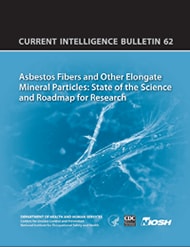
NIOSH Issues "Roadmap" Document Suggesting Asbestos Research Strategy
The National Institute for Occupational Safety and Health (NIOSH) announces the availability of “Current Intelligence Bulletin: Asbestos Fibers and Other Elongate Mineral Particles: State of the Science and Roadmap for Research.” The document contains NIOSH’s recommended framework for a national research strategy to address current scientific uncertainties about occupational exposure and toxicity issues relating to asbestos fibers and other elongate mineral particles.
The Current Intelligence Bulletin is available online at www.cdc.gov/niosh/docs/2011-159/.
It is well documented that asbestos fibers can cause lung cancer and other types of serious lung disease in workers when inhaled. Since the passage of the Occupational Safety and Health Act in 1970, considerable progress has been made in preventing harmful exposures and protecting workers from risks of illness. However, many scientific uncertainties remain as to the health risks associated with exposure to other elongate mineral particles, including those with mineralogical compositions identical or similar to the asbestos minerals and those that have already been documented to cause asbestos-like disease, as well as the physical and chemical characteristics that determine toxicity.
The new NIOSH document incorporates extensive public comment and scientific peer review, including review by an independent committee of the Institute of Medicine and the National Research Council. The document does not set any new NIOSH policy regarding asbestos fibers and other elongate mineral particles.
“The NIOSH roadmap outlines a strategic framework for designing, conducting, and applying the research that will best serve the need to address persistent scientific uncertainties about occupational health and elongate mineral particles,” said NIOSH Director John Howard, M.D. “We look forward to working with our partners to advance this research, building on today’s state-of-the-art scientific tools and methodologies.”
Priority areas for research, as proposed by the roadmap, include:
- Developing a broader understanding of the factors that determine the toxicity of asbestos fibers and other elongate mineral particles.
- Developing information and knowledge on occupational exposures to asbestos fibers and other elongate mineral particles, and related health outcomes.
- Development of improved sampling and analytical methods for asbestos fibers and other elongate mineral particles.
- Applying research outcomes to improve public policy.
NIOSH is the federal agency that conducts research and makes recommendations for preventing work-related injury, illness, and death. NIOSH has a longstanding program of research and health surveillance to prevent asbestos-related disease, and its scientific findings and recommendations have contributed significantly to national policies for eliminating or minimizing harmful exposures. Further information is available at www.cdc.gov/niosh/topics/asbestos/.
For over 3 decades the Law Offices of Jon L. Gelman 1.973.696.7900 jon@gelmans.com have been representing injured workers and their families who have suffered asbestos related disease.
Related articles
- Exporting Without Remorse: How Canada is Exporting Toxins to the 3rd World (filipspagnoli.wordpress.com)
- Benefits Available Under the Zadroga 9/11 Victim Compensation Fund
- UN Agency Urges Worldwide Asbestos Ban
- Big Labour Pulls Support for Asbestos (montrealgazette.com)
MIssouri Mulls More Work Comp Reform
Guest Blog by B. Michael Korte
Related articles
The Missouri legislature is again considering a number of proposals to change its workers’ compensation system. Every year brings various efforts to continue to ratchet down the benefits provided to injured workers, but this year is the first since 2005 that any change is expected. That year, extensive changes were passed, including a requirement that cases be construed "strictly" rather than liberally.
Strict construction has proven to be a two-edged sword, with courts recently strictly construing Missouri law to allow more civil lawsuits against fellow employees, and perhaps excluding occupational diseases from the workers’ compensation system and allowing them to proceed in the civil court system.
Legislation will almost certainly pass in the pro-business-dominated legislature to close these loopholes. What remains to be seen is whether the legislature will finally act to save the state’s second injury fund.
The 2005 legislation placed a hard cap on funding for the fund, which has left it nearly bankrupt. The fund stopped making settlement offers in 2009, but now is finding itself unable to pay arrearages on permanent total disability awards. Although numerous independent audits agree that lifting the cap would solve the problem, legislative proposals are focusing instead on limiting or eliminating the fund.
The legislature will have until its adjournment on May 13 to solve the problem, but will also be consumed with budgetary and other problems in the meantime.
B. Michael Korte practices in Kirkwood, Missouri (The Korte Law Firm). B. Michael Korte is the author of Missouri Practice Vol. 29, Workers Compensation Law and Practice. He previously served as president of the Missouri Association of Trial Attorneys, and has been awarded its Outstanding Service Award. He previously served as president of the Missouri Association of Trial Attorneys, and has been awarded its Outstanding Service Award. He frequently lectures statewide at seminars sponsored by the Missouri Division of Workers’ Compensation, bar associations, and other groups. He has served as the chair of the Missouri Bar Association Workers’ Compensation Committee and as President of Kids’ Chance, Inc., a workers compensation charity.
Related articles
- Montana Targets Workers Compensation to Reduce Deficit Spending (workers-compensation.blogspot.com)
- Rescue Legislation for Missouri Second Injury Fund Fails (workers-compensation.blogspot.com)
- NJ Second Injury Fund is in Financial Trouble (workers-compensation.blogspot.com)
- Worker's Comp, Walker, and Wisconsin's Wailing (workers-compensation.blogspot.com)
- RICO Issues Can Be Cured With A Single Payer Medical System (workers-compensation.blogspot.com)
- Industry Coalition Wants to Cut CMS Conditional Payments (workers-compensation.blogspot.com)
- An Important History Lesson In Workplace Safety Laws (workers-compensation.blogspot.com)
Wednesday, March 23, 2011
OSHA Advances Recording of Musculoskeletal Disorders
The U.S. Department of Labor's Occupational Safety and Health Administration, in partnership with the Small Business Administration's Office of Advocacy, today announced a series of three teleconferences to reach out to the small business community for input on OSHA's proposal to add a column for work-related musculoskeletal disorders on employer injury and illness logs. This proposal would require those employers already mandated to keep injury and illness records to add the step of checking a column when recording work-related musculoskeletal disorders.
Small businesses from around the country are encouraged to participate in the teleconferences. The first will be held on Monday, April 11 at 1:30 p.m. EDT. The second and third will be held Tuesday, April 12, 2011, at 9 a.m. EDT and 1:30 p.m. EDT. Participants may provide input about their experiences in recording work-related MSDs and how they believe the proposed rule would impact them.
The proposed rule only covers MSDs that employers are already required to record under the longstanding OSHA rule on recordkeeping. Prior to 2001, OSHA's injury and illness logs contained a column for repetitive trauma disorders that included hearing loss and many kinds of MSDs. In 2001, OSHA proposed separating hearing loss and MSDs into two columns, but the MSD column was deleted in 2003 before the provision became effective. OSHA's proposal would restore the MSD column to the Form 300.
Interested businesses that wish to participate in one of the teleconferences should contact Regina Powers at powers.regina@dol.gov by April 4, and indicate the teleconference in which they wish to participate. For more information, contact Robert Burt, director of OSHA's Office of Regulatory Analysis, at 202-693-1952 or Bruce Lundegren, assistant chief counsel for SBA Advocacy, at 202-205-6144.
Additional information is available online at Injury Tracking Application (ITA) Information
Related articles
- OSHA Fines NJ Contractor $45,450 For Safety Violations (workers-compensation.blogspot.com)
- Conference- The Triangle Shirtwaist Fire and its Legacy: Out of the Smoke and the Flame (workers-compensation.blogspot.com)
- US Labor Department Launches Mobile-Optimized Website to Commemorate 100th Anniversary of Triangle Shirtwaist Factory Fire (workers-compensation.blogspot.com)
- The James Zadroga 9/11 Health & Compensation Act of 2010 (workers-compensation.blogspot.com)
- Injuries, Illnesses, and Fatalities Latest Numbers (bls.gov)
TRIANGLE'S ECHOES: The Unfinished Struggle for Worker Protection, Safety and Health
How far have we really come the since 1911, when the Triangle shirtwaist factory fire killed 146 people, most of them immigrant women, nearly half still in their teens? This film was commissioned by the National Consumers League and the planning Committee for the
Washington DC Triangle Shirtwaist Factory Fire 100th Anniversary symposium.
Click here to view the film: http://youtu.be/xN8cjH5qfRk
Related articles
Washington DC Triangle Shirtwaist Factory Fire 100th Anniversary symposium.
Click here to view the film: http://youtu.be/xN8cjH5qfRk
Related articles
- HBO To Air Special of Triangle Shirtwaist Fire (workers-compensation.blogspot.com)
- An Important History Lesson In Workplace Safety Laws(workers-compensation.blogspot.com)
- Conference- The Triangle Shirtwaist Fire and its Legacy: Out of the Smoke and the Flame (workers-compensation.blogspot.com)
- John Seabrook: The hundredth anniversary of the Triangle Shirtwaist Factory fire. (newyorker.com)
- 100th Anniversary Of Deadly Triangle Shirtwaist Fire Approaches (newyork.cbslocal.com)
- Remembering the Triangle Fire, 100 Years Later(cityroom.blogs.nytimes.com)
- US Labor Department - Website to Commemorate 100th Anniversary of the Triangle Shirtwaist Fire (workers-compensation.blogspot.com)
- Commemoration-Triangle Shirtwaist Fire: A Century Later (workers-compensation.blogspot.com)
Tuesday, March 22, 2011
Playing the TSA Cancer Lottery
The Japanesse nuclear reactor radiation leak and the risk taken by the Fukusima workers, as well as in food contamination, has focussed increased concern about the unsafe use of radiation equipment used by the Transportation Safety Administration (TSA) in x-ray machines to scan passengers at airports. David Brenner, Phd,DSr, a researcher at The Center for Radiological Research at Columbia University in New York, reports that TSA's use of the machines will create an increase risk to passenger by causing an additional 100 cancers in the population each year. He calls for the use of different equipment to screen passengers.
At a US Senate hearing last week, Senator Susan Collins (R-Maine) revealed that TSA had made reporting errors in the statistics it has compiled in defense of the use of body scanners. "That is completely unacceptable when it comes to monitoring radiation," Collins said. "If TSA contractors reporting on the radiation levels have done such a poor job, how can airline passengers and crew have confidence in the data used by the TSA to reassure the public?"
Related articles
- Airport scanner radiation data to be posted (cbc.ca)
- TSA defends screening radiation risks again (cbsnews.com)
- Expert: TSA scanners may cause 100 cancer cases a year (philly.com)
- UPDATE 1-US to publish radiation data from airport screening (reuters.com)
- TSA orders 're-tests' of radiation levels on body scanners (cnn.com)
- A Nuclear Workers' Compensation Disaster (workers-compensation.blogspot.com)
- Breast Cancer Presumed Occupational Illness (workers-compensation.blogspot.com)
Subscribe to:
Comments (Atom)