Copyright

(c) 2010-2026 Jon L Gelman, All Rights Reserved.

Sunday, November 3, 2013

Exposures Caused by Dampness in Office Buildings, Schools, and Other Nonindustrial Buildings

Office buildings, schools, and other nonindustrial buildings may develop moisture and dampness problems from roof and window leaks, high indoor humidity, and flooding events, among other things.

For this Alert, we buildings [AIHA 2008]. This can lead to the growth of mold, fungi, and bacteria; the release of volatile organic compounds; and the breakdown ofice bn wet materials. Outdoors,molds live in the soil, on plants, and on dead or decaying matter.

There are thousands of species of molds and they can be any color. Different mold species can adapt to different moisture conditions.

Research studies have shown that exposures to building dampness and mold have been associated with respiratory symptoms, asthma, hypersensitivity pneumonitis, rhinosinusitis, bronchitis, and respiratory infections.

Individuals with asthma or hypersensitivity pneumonitis may be at risk for progression to more severe disease if the relationship between illness and exposure to the damp building is not recognized and exposures continue.

NIOSH Alert: Preventing Occupational Respiratory Disease from Exposures Caused by Dampness in Office Buildings, Schools, and Other Nonindustrial Buildings [PDF - 1.25 MB]
[Click here to see the rest of this post]

Saturday, November 2, 2013

Are Caregivers Healthier?

Today's post was shared by The New Old Age and comes from newoldage.blogs.nytimes.com


The idea that caring for a chronically ailing or disabled family member might be good for you is so startling, so counterintuitive, that it sends researchers rummaging through their data to see where they went wrong.

“There are hundreds of studies about how caregiving is stressful and bad for your health,” said David Roth. As director of the Johns Hopkins Center on Aging and Health, and someone who has spent 15 years compiling caregiving data, he has probably read most of them.

But his recent study in The American Journal of Epidemiology is the most recent to lend support to an emerging counter perspective, dubbed the “healthy caregiver hypothesis.”

Inserting a few key questions into a large national stroke study, his team was able to compare about 3,500 family caregivers older than 45 with noncaregivers of the same age, gender, education level and self-reported health. The researchers also matched caregivers and noncaregivers for cognitive status and for health behaviors like smoking and drinking — 15 variables in all. The caregivers included spouses (about 22 percent of the 3,500 followed), adult children caring for parents (about a third), and people caring for other family members.

After an average six-year follow-up, he and his colleagues found that the noncaregivers had 
significantly higher mortality rates. Nine percent of them had died, compared with 7.5 percent of caregivers, who were 18 percent less likely to die during the six-year...
[Click here to see the rest of this post]

Friday, November 1, 2013

Johns Hopkins medical unit rarely finds black lung, helping coal industry defeat miners' claims

Today's post was shared by FairWarning and comes from www.publicintegrity.org


There is an unmistakable pattern in Wheeler’s readings. The Center identified more than 1,500 cases decided since 2000 in which Wheeler read at least one X-ray; in all, he interpreted more than 3,400 films during this time.

The numbers show his opinions consistently have benefited coal companies:
  • Wheeler rated at least one X-ray as positive in less than 4 percent of cases. Subtracting the cases in which he ultimately concluded another disease was more likely, this number drops to about 2 percent.
  • In 80 percent of the X-rays he read as positive, Wheeler saw only the earliest stage of the disease. He never once found advanced or complicated black lung. Other readers, looking at the same images, saw these severe forms of the disease on more than 750 films.
  • Where other doctors saw black lung, Wheeler saw tuberculosis, histoplasmosis or a similar disease on about 34 percent of X-rays. This number shoots up in cases in which others saw complicated black lung, which is so severe it triggers automatic compensation. In such cases, Wheeler attributed the masses in miners’ lungs to these other diseases on two-thirds of X-rays.
Asked if he stood by this record, Wheeler said, “Absolutely.”

Delivering High-Quality Cancer Care: Charting a New Course for a System in Crisis

Today's post was shared by CDC Cancer and comes from iom.edu 

In the United States, approximately 14 million people have had cancer and more than 1.6 million new cases are diagnosed each year. By 2022, it is projected that there will be 18 million cancer survivors and, by 2030, cancer incidence is expected to rise to 2.3 million new diagnoses per year. However, more than a decade after the IOM first studied the quality of cancer care, the barriers to achieving excellent care for all cancer patients remain daunting. Therefore, the IOM convened a committee of experts to examine the quality of cancer care in the United States and formulate recommendations for improvement. Delivering High-Quality Cancer Care: Charting a New Course for a System in Crisis presents the committee’s findings and recommendations.


The committee concluded that the cancer care delivery system is in crisis due to a growing demand for cancer care, increasing complexity of treatment, a shrinking workforce, and rising costs. Changes across the board are urgently needed to improve the quality of cancer care. All stakeholders – including cancer care teams, patients and their families, researchers, quality metrics developers, and payers, as well as HHS, other federal agencies, and industries – must reevaluate their current roles and responsibilities in cancer care and work together to develop a higher quality cancer care delivery system. Working toward the recommendations outlined in this report, the cancer care community can improve the quality...


[Click here to see the rest of this post]


Related articles

Can better working conditions improve the performance of SMEs?

Today's post is shared from the Internal Labour Organization ilo.org

This study reviews the literature on the link between working conditions, safety and health and skills development, on the one hand, and increased productivity on the other, with a specific focus on small and medium-sized enterprises (SMEs). The writers find research evidence of an association between good workplace practices and various types of positive enterprise-level outcomes. These positive outcomes include reduced employee turnover, improved profitability and higher levels of customer satisfaction.

The literature surveyed consists in the main of studies of high-income economies and rather than unpacking the influence of different practices these studies serves to affirm that practices have best results when they are employed together. So, for example, a coherent ‘bundle of practices’ , combining good occupational safety and health and training with improved working hours and wages will generally improve productivity, innovation and employee retention. The review also finds evidence of a cause and effect, suggesting that better management practices lead to improved business outcomes rather than vice versa.

Despite all of the above, the review highlights that more research is needed. In particular, the researchers note the lack of literature analysing the complexity of the relationship between working conditions, safety and health, skills development, and firm outcomes. They also note the need for research in this area in developing and emerging...
[Click here to see the rest of this post]

OSHA releases new resources to better protect workers from hazardous chemicals

Each year in the United States, tens of thousands of workers are made sick or die from occupational exposures to the thousands of hazardous chemicals that are used in workplaces every day. The U.S. Department of Labor's Occupational Safety and Health Administration today launched two new web resources to assist companies with keeping their workers safe.

While many chemicals are suspected of being harmful, OSHA's exposure standards are out-of-date and inadequately protective for the small number of chemicals that are regulated in the workplace. The first resource OSHA has created is a toolkit to identify safer chemicals that can be used in place of more hazardous ones. This toolkit walks employers and workers step-by-step through information, methods,
tools and guidance to either eliminate hazardous chemicals or make informed substitution decisions in the workplace by finding a safer chemical, material, product or process. The toolkit is available at http://www.osha.gov/dsg/safer_chemicals/index.html.

"We know that the most efficient and effective way to protect workers from hazardous chemicals is by eliminating or replacing those chemicals with safer alternatives whenever possible," said Dr. David Michaels, assistant secretary of labor for occupational safety and health.

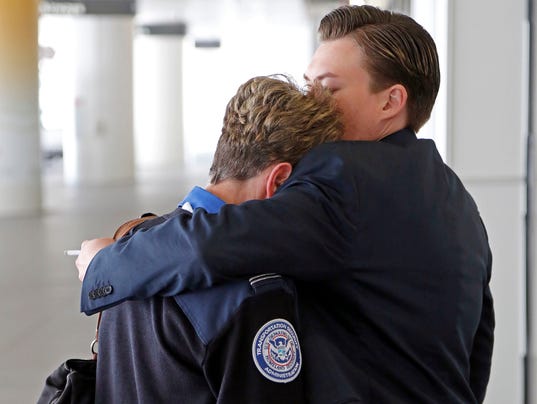
LAX shooting suspect identified; TSA agent dead

Violence in the workplace at Los Angeles Airport resulted in at least one fatality and multiple people being injured. Apparently TSA agents were targeted. TSA employees are unarmed. Today's post is shared from shared from usatoday.com

A lone gunman armed with a semi-automatic rifle went on a shooting spree Friday at Los Angeles International Airport, killing one person and leaving at least six people injured before the suspect was tracked down and taken into custody.
"We have one deceased,'' Capt. Brian Elias of the Los Angeles County Coroner's office told USA TODAY.
Tim Kauffman, a spokesman for the American Federation of Government Employees in Washington, told the Associated Press that the victim who died was a Transportation Security Administration officer. He said the union's information came from its local officials in Los Angeles.
Law enforcement officials identified the suspect as 23-year-old Paul Ciancia.
Airport police chief Patrick Gannon said the gunman forced his way past a TSA checkpoint into the heart of LAX Terminal 3.
He said authorities believe the gunman acted alone.
Ciancia, a U.S. citizen, was shot in the face in the confrontation with police, a federal law enforcement official said. The official, who was not authorized to speak publicly, said the suspect had survived the shooting but his condition was not immediately known.
One TSA officer is the only person confirmed dead, the official said.
Gannon said the shooting began at 9:20 a.m. PT, when the suspect pulled an "assault rifle" out of a bag and began to open fire in LAX Terminal 3.
"He proceeded up to...
[Click here to see the rest of this post]

California state Sen. Ron Calderon accepted $88,000 in bribes, FBI affidavit alleges

California workers' compensation scandal headlines the news over medical treatment bribes.  Today's post is shared from sacbee.com

State Sen. Ron Calderon accepted about $88,000 in bribes from an undercover FBI agent posing as a film studio owner and a Southern California hospital executive during a wide-ranging probe into his conduct as a legislator, according to a 124-page affidavit published online Wednesday by cable news network Al Jazeera America.
No charges have been filed against Calderon, a Democrat from Montebello. His attorney, Mark Geragos, did not return calls Wednesday.
The federal affidavit, filed with the court under seal as the FBI sought a search warrant for Calderon’s office, alleges that he worked with interest groups in a pay-to-play fashion, accepting money in exchange for promises to carry or amend legislation to their benefit.
GBHSQ753.3It details an arrangement to funnel money for the Calderon family’s later use through a nonprofit organization run by his brother Tom Calderon. It describes an instance in which Calderon hired a female undercover agent as a staff member as a favor to another undercover agent despite her apparent lack of qualifications for the job. It says that as Calderon steered legislation, he asked those he thought would benefit to secure jobs for his children, Jessica and Zachary.
“One way you could be a real help to (my daughter) is, you got any work?” Calderon said to an undercover agent posing as the film studio owner during a June 2012 dinner in Pico Rivera, according to the affidavit.
“I told you, man, anything...
[Click here to see the rest of this post]

As Robot-Assisted Surgery Expands, Are Patients And Providers Getting Enough Information?

Today's post is shared from kaiserhealthnews.org.

The use of robotic surgical systems is expanding rapidly, but hospitals, patients and regulators may not be getting enough information to determine whether the high tech approach is worth its cost.

Problems resulting from surgery using robotic equipment—including deaths—have been reported late, inaccurately or not at all to the Food and Drug Administration, according to one study.
The study, published in the Journal for Healthcare Quality earlier this year, focused on incidents involving Intuitive Surgical’s da Vinci Robotic Surgical System over nearly 12 years, scrubbing through several data bases to find troubled outcomes. Researchers found 245 incidents reported to the FDA, including 71 deaths and 174 nonfatal injuries. But they also found eight cases in which reporting fell short, including five cases in which no FDA report was filed at all.

The FDA assesses and approves products based on reported device-related complications. If a medical device malfunctions, hospitals are required to report the incident to the manufacturer, which then reports it to the agency. The FDA, in turn, creates a report for its Manufacturer and User Facility Device Experience database.

The use of surgical robots has grown rapidly since it was first approved for laparoscopic surgery (a type of surgery that uses smaller incisions than in traditional surgery) by the FDA in 2000. Between 2007 and 2011 the number of da Vinci systems installed increased by 75 percent in the United...
[Click here to see the rest of this post]

EPA Fines Phoenix-based Company $95,000 for PCB violations

Today's post was shared by US EPA News and comes from yosemite.epa.gov


SAN FRANCISCO – The U.S. Environmental Protection Agency has required Veolia ES Technical Solutions, LLC to pay a $95,000 civil penalty for failure to properly manage PCBs (polychlorinated biphenyls) at its Jefferson Avenue facility in Phoenix, Ariz. 

The violations stemmed from two inspections in 2008 and 2010. EPA inspectors found the company used PCB-contaminated structures, and improperly stored and disposed of PCBs in violation of the federal Toxic Substances Control Act.“Our goal is to safeguard workers and nearby communities from the health hazards of PCBs,” said Jared Blumenfeld, EPA’s Regional Administrator for the Pacific Southwest

“This settlement ensures that Veolia will take necessary steps to improve its storage and disposal practices.”Veolia Environmental Services North America, the parent company of Veolia ES Technical Solutions, LLC, employs over 5,400 staff generating $1.1 billion in revenues in 2012. 

The company specializes in the management, treatment and disposal of waste. PCBs are man-made organic chemicals used in paints, industrial equipment, plastics, and cooling oil for electrical transformers. 

More than 1.5 billion pounds of PCBs were manufactured in the United States before the EPA banned the production of this chemical class in 1978, and many PCB-containing materials are still in use today....
[Click here to see the rest of this post]

Former Winchester, Idaho hotel owner settles with EPA for asbestos demolition violations

Today's post was shared by US EPA News and comes from yosemite.epa.gov


(Seattle – October 28, 2013) BBA Winchester LLC, the owner of a former hotel located in Winchester, Idaho has settled with EPA and agreed to pay a $21,000 fine for asbestos safety and environmental violations from improper demolition of the hotel. 

“This is an unfortunate example that when asbestos is not properly removed before demolition, the entire debris pile becomes contaminated, putting people at risk, and greatly increasing disposal costs,” said Scott Downey, Manager of the Air and Hazardous Waste Compliance Unit at the EPA Seattle office. 

“Because this owner failed to check for asbestos before demolition, their $2,000 demolition project ballooned into a $55,000 asbestos waste cleanup and disposal problem.”In response to public complaints, EPA inspected the demolition site of the former hotel in 2012. 

BBA Winchester LLC demolished the 100-year-old hotel in late 2011 or early 2012, without first inspecting the building for asbestos, removing asbestos materials, or notifying EPA, as required by law. 

The demolition was in a residential neighborhood and the contaminated debris was unsecured for more than a year, prompting community concerns about asbestos health risks. EPA inspectors collected samples from the site that showed the demolition debris contained regulated asbestos waste. After confirming the debris was...
[Click here to see the rest of this post]

EPA Extends Public Comment Period on Cleanup Plan for Maywood Chemical Company Superfund Site

Today's post was shared by US EPA News and comes from yosemite.epa.gov


The U.S. Environmental Protection Agency has extended the public comment period for its proposed cleanup plan to address contaminated soil at the Maywood Chemical Company Superfund site in Maywood and Rochelle Park, New Jersey

The Agency is extending the comment period, which was set to end on October 22 to November 21. 

Previous industrial activity at the site resulted in contamination of the soil and ground water with volatile organic compounds, radioactive waste and metals. 

The EPA proposal calls for a combination of removing and treating contaminated soil. 

The EPA held a public meeting on September 9, 2013 to explain the proposed plan. For more information and to view the proposed plan, visit http://epa.gov/region02/superfund/npl/maywood
[Click here to see the rest of this post]

Canadian Pipeline Incidents Have Doubled In The Past Decade

Today's post was shared by Huffington Post and comes from www.huffingtonpost.com


Oct 28 (Reuters) - The rate of safety-related incidents on federally regulated pipelines in Canada doubled over the last decade, while the rate of reported spills and leaks was up threefold, according to an investigative report by Canada's national broadcaster.

The total number of incidents, which included everything from spills to fires, swelled from 45 in 2000 to 142 in 2011, the CBC reported on Monday, citing data from the National Energy Board (NEB) obtained through access-to-information requests.

That translated to a doubling from one incident for every 1,000 km (620 miles) of federally-regulated pipeline in 2000, to two in 2011.

The CBC investigation also found that the rate of product reported releases - spills and leaks - rose threefold, from four releases for every 10,000 km in 2000, to 13 in 2011.

The NEB regulates all pipelines that cross provincial or international borders, but does not monitor smaller pipelines that are only in a single province.

The safety of shipping petroleum products via pipelines has become a hot topic in recent years, with companies like Enbridge Inc and TransCanada Corp developing major new projects to move crude from Canada's oil sands to markets in the United States and Asia.

Opponents say a pipeline leak can cause catastrophic environmental damage and often cite a 2010 incident where an Enbridge pipeline carrying crude from Alberta ruptured, spilling huge amounts of oil into the Kalamazoo River in Michigan.

But pipeline companies say their...
[Click here to see the rest of this post]

SeaWorld Appeal Could Force Taming Of Its Popular Shows

Today's post was shared by Huffington Post and comes from www.huffingtonpost.com

SeaWorld Appeal
By Carlyn Kolke

(Reuters) - A killer whale, the lawyer-son of a Supreme Court justice and the grisly death of wildlife trainer will play roles in a U.S. appeals court case next month that could forever change marine park operator SeaWorld's marquee entertainment.

The signature attraction for the company's three U.S. theme parks has been shows featuring the black-and-white killer whales or orcas, including several named Shamu, performing flips and other stunts under the direction of trainers who historically have been in close contact with them.

But that changed after the February 2010 death of Dawn Brancheau, a 40-year-old trainer. She drowned after being pulled into a pool by Tilikum, a 12,000-pound bull orca, at SeaWorld's site in Orlando, Florida.

In August 2010, the U.S. Occupational Safety and Health Administration (OSHA) fined SeaWorld $75,000 for three safety violations, saying it had exposed its trainers to a hazardous environment and violated a part of the Occupational Safety and Health Act known as the general duty clause.

OSHA, a part of the Labor Department, demanded SeaWorld make certain changes, notably, physically separating the killer whale trainers from the orcas during show performances.

SeaWorld is appealing the broad application of a federal safety law meant to protect workers in unusual circumstances. The case will come before a three-judge panel of the U.S Court of Appeals for the District of Columbia Circuit on Nov. 12.

With animal...
[Click here to see the rest of this post]

CDC - Storm/Flood and Hurricane Response - NIOSH Workplace Safety and Health Topic

Today's post was shared by Safe Healthy Workers and comes from www.cdc.gov


hospital worker, firefighter, police officer, hazmat cleanup worker

Storm and flood cleanup activities can be hazardous. Workers and volunteers involved with flood cleanup should be aware of the potential dangers involved, and the proper safety precautions. Work-related hazards that could be encountered include: electrical hazards, Carbon Monoxide, musculoskeletal hazards, heat stress, motor vehicles, hazardous materials, fire, confined spaces and falls. Links to information about hazards associated with storm and flood cleanup can be found below. This information is intended to help employers and workers prepare in advance for anticipated response activities, and to prevent work-related injuries and illnesses in the field once rescue, recovery, and clean-up begin.
What Services Can CDC/NIOSH Provide to Employers and Employees Involved in Hurricane Recovery? Provides information on work site hazard evaluations available to workers affected by hurricane recovery.


Generator Safety

Preventing electrocutions associated with portable generators plugged into household circuits


Medical Recommendations for Relief Workers and Emergency Responders

NIOSH Interim Guidance for Pre-exposure Medical Screening of Workers Deployed for Hurricane Disaster Work
This document provides interim guidance on medical screening for workers before beginning disaster response activities. It will be updated or revised as appropriate, as additional information becomes available. These materials were...
[Click here to see the rest of this post]

Two Kinds of Hospital Patients: Admitted, and Not

Today's post was shared by The New Old Age and comes from newoldage.blogs.nytimes.com


Judith Stein got a call from her mother recently, reporting that a friend was in the hospital. “Be sure she’s admitted,” Ms. Stein said.
As executive director of the Center for Medicare Advocacy, she has gotten all too savvy about this stuff.
“Of course she’s admitted,” her mother said. “Didn’t I just tell you she was in the hospital?”
But like a sharply growing number of Medicare beneficiaries, her mother’s friend would soon learn that she could spend a day or three in a hospital bed, could be monitored and treated by doctors and nurses — and never be formally admitted to the hospital. She was on observation status and therefore an outpatient. As I wrote last year, the distinction can have serious consequences.
The federal Centers for Medicare and Medicaid Services tried to clarify this confusing situation in the spring with a policy popularly known as the “two-midnight rule.” When a physician expects a patient’s stay to include at least two midnights, that person is an inpatient whose care is covered under Medicare Part A, which pays for hospitals. If it doesn’t last two midnights, Medicare expects the person to be an outpatient, and Part B, which pays for doctors, takes over.
It’s rare to have hospital and nursing home administrators, physicians and patient advocates all agreeing about a Medicare policy, but in this case “there’s unanimity of dislike,” said ...
[Click here to see the rest of this post]

Prevention For Profit: Questions Raised About Some Health Screenings

Today's post was shared by Kaiser Health News and comes from www.kaiserhealthnews.org


Messiah United Methodist Church in Springfield, Va., is unusually busy for a Thursday morning. It's not a typical time for worship, but parishioner Stacy Riggs and her husband have come for something a little different: a medical screening.

"I'm getting ready to turn 50 sooner than I'd like to say, and just thought it was a good time to get an overall screening," said Riggs, of Fairfax, Va. She doesn't have any symptoms, but she stopped by the church, which is offering a day of testing by the company Life Line Screening as a service to parishioners.

(Photo by Jenny Gold)
Life Line Screening medical assistant Kennea Blake prepares Stacy Riggs for an atrial fibrillation screening at Messiah United Methodist Church in Springfield, Va.

For less than $200, Riggs is getting six different screenings for stroke, heart disease and osteoporosis. Life Line says they've checked 8 million Americans this way at churches and community centers, and up to 10 percent of them are found to have some sort of abnormality.

But several of the tests performed by Life Line are on a list of procedures for healthy people to avoid.

The tests can potentially do more harm than good, according to the U.S. Preventive Services Task Force, an independent panel that recommends evidence-based treatments. Even though the screening tests may be noninvasive, follow-up exams and procedures often are not, and can increase a person's odds of being injured or over treated.

One of those tests is the carotid artery...
[Click here to see the rest of this post]