Copyright

(c) 2010-2026 Jon L Gelman, All Rights Reserved.

Tuesday, November 17, 2009

Compensating Sick Workers at Home with H1N1 Flu


While the United States has established a national protocol to meet the medical challenges H1N1 flu pandemic, there remains a void on how to pay workers who are ill and have been encouraged by the government to stay home.  The litigious workers' compensation adversarial system may provide benefits ultimately for those who can demonstrate that their illness "arose out of and occurred in the course of the employment," after months, if not years, of delay. 


Some states have temporary disability programs, fraught with bureaucratic delay and red tape, while the issues of denial in the workers' compensation claims become identified. If held to be compensable, reimbursement is then sought by the temperate disability plan, public or private, 


The issues of a lack of an efficient wage replacement system for those workers affected by the H1N1 flu will be addressed by Congress shortly. The chorus of advocacy is increasing as this debate advances. The following is a recent post from the occupational-environmental mailing list setting forth a pretty persuading argument to establish a plan to pay sick workers with H1N1 flu.


Sick At Work

When the first cases of the H1N1 virus (swine flu) were confirmed in America back in April, the Centers for Disease Control and Prevention advised that sick individuals stay home from work or school. "Influenza is thought to spread mainly person-to-person through coughing or sneezing of infected people," the CDC said."If you get sick, CDC recommends that you stay home from work or school and limit contact with others to keep from infecting them." However, for many Americans, staying home from work due to illness -- or to care for a sick child -- is an impossibility because of a lack of job-protected paid sick days. In response to the threat posed by H1N1, Rep. George Miller (D-CA) has proposed legislation that would "guarantee five paid sick days to employees at businesses with 15 or more workers who are directed to stay home by management." However, Miller's plan sunsets in two years and gives employers, not employees, the right to decide when leave is taken. Plus, under Miller's plan, employees cannot use leave time to care for a sick child. The Healthy Families Act (HFA), which is also before Congress, would guarantee seven paid sick days per year to all workers at firms with 15 or more employees. "Paid sick days has always been a good, common sense idea, but, in light of the recent H1N1 epidemic, it has also become a necessary one," said Rep. Rosa DeLauro (D-CT), an HFA sponsor. "Right when more and more workers are feeling economically vulnerable and afraid to even miss one workday, we face an extraordinarily serious health risk that spreads much more quickly if the sick do not stay at home." Last week, the Obama administration officially agreed, and endorsed the HFA.

LOW-INCOME WORKERS HIT THE HARDEST: 
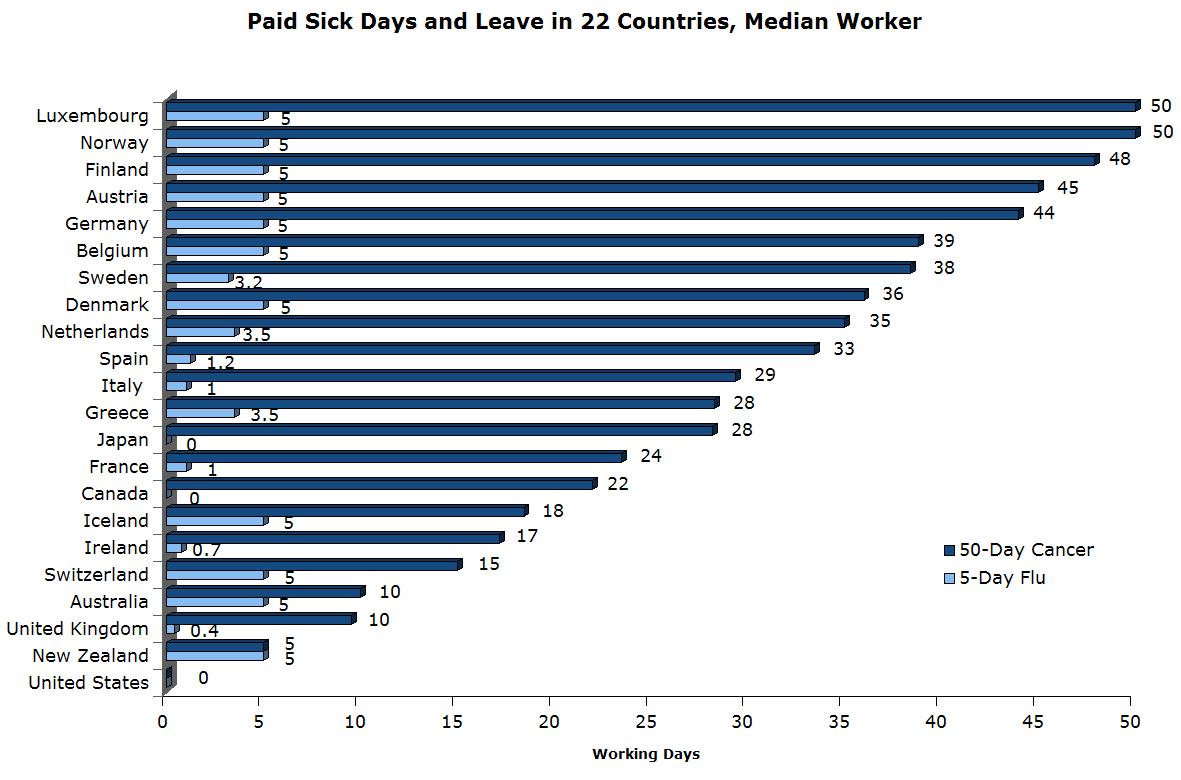
The U.S. is currently the only developed nation that does not require some paid sick leave for workers. Nearly 40 percent of private sector workers have no paid sick leave, including 78 percent of hotel workers and 85 percent of food service workers. A survey last year by the National Opinion Research Center at the University of Chicago found that "68 percent of those not eligible for paid sick days said they had gone to work with a contagious illness like the flu." As CAP Senior Fellow Ann O'Leary and Karen Kornbluh, U.S. Representative to the Organisation for Economic Co-operation and Development, pointed out in The Shriver Report: A Women's Nation Changes Everything, "too often, most low- and many moderate-wage workers cannot access even the minimum benefits provided to more highly paid workers." And this is true of paid sick leave, as 88 percent of workers in the top 10 percent of wage earners have it, compared to just 22 percent of workers in the bottom 10. "Hopefully, employers are doing the right thing and not disciplining workers who are out sick as a result of the flu," wrote Center for American Progress Senior Economist Heather Boushey. "But there's no penalty for employers who choose not to pay workers in this situation, or who refuse workers any time off at all."

A BETTER BUSINESS MODEL: 
Big business organizations have panned the notion of required sick leave, with the Chamber of Commerce saying that "
the problem is not nearly as great as some people say," and the National Association of Manufacturers warning that the HFA "would impose an inflexible government mandate on employers, making it more difficult for manufacturers to preserve and create jobs." However, lost productivity due to sick workers attending work and infecting others costs the U.S. economy $180 billion annually. For employers, the cost averages $255 per employee per year and "exceeds the cost of absenteeismand medical and disability benefits." The National Partnership for Women and Families actually found that "while a paid sick days policy would impose modest costs, the estimated business savings total $11.69 per week per worker from lower turnover, improved productivity and reduced spread of illness." The Center for Economic and Policy Research has also concluded that "there is no significant relationship between national unemployment rates and legally-mandated access to paid sick days." "When businesses take care of their workers, they are better able to retain them, and when workers have the security of paid time off, their commitment, productivity and morale increases, and employers reap the benefits of lower turnover and training costs," said National Partnership President Debra Ness.

LOCAL EFFORTS: 
Two major cities -- San Francisco and Washington, D.C. -- have implemented mandatory paid sick leave policies, while a third -- Milwaukee -- has passed the requirement, only to see it tied up in court. In addition, 15 states have proposed mandatory sick leave laws. 
"We are all being advised by our doctors to stay home if we're sick, but that is a cruel piece of advice if you don't have paid sick time," Maine Senate President Elizabeth Mitchell said. New York City is also looking at mandatory leave, which Mayor Michael Bloomberg has expressed support for, at least for the city's large employers. New York's proposed requirement would also allow workers to stay home in the event their child's school was closed for public health reasons. "Many working parents suffered this past spring because their children's schools were closed even though their children were not sick," said Donna Dolan, chairwoman of the New York State Paid Family Leave Coalition.

To read more about flu and workers' compensation click here.


NIOSH Reports on the Safety of Nanotechnology

The emerging area of nanotechnology has brought with it concerns over worker safety. NIOSH has now released a progress report concerning this technology. NIOSH's goals are:

1. Determine whether nanoparticles and nanomaterials pose risks of work-related injuries and illnesses.
2. Conduct research to prevent work-related injuries and illnesses by ap- plying nanotechnology products.
3. Promote healthy workplaces through interventions, recommendations, and capacity building.
4. Enhance global workplace safety and health through national and international collaborations on nanotechnology research and guidance.

"To date, NIOSH/OEP has committed about $5.3 million dollars to research on applications and implications of nanotechnology. Summaries of the projects funded by NIOSH/OEP are included in Appendix B. NIOSH/OEP plans to continue collaborative efforts with EPA/NCER, NSF, NIH/NIEHS, and other international agencies to support nanotechnology research with occupational safety and health implications. OEP will continue to confer with the NIOSH Nanotechnology Research Center regarding issues, gaps, and future directions.

To read more about nanotechnology click here.

Monday, November 16, 2009

WC Attorney Liable for $359M+ in Legal Malpractice Claim

A NJ workers' compensation attorney who failed to pursue a medical malpractice claim and allowed it to be dismissed was held liable for legal malpractice. The client was injured when a physician punctured the workers' kidney while administering an epidural injection.


To complicate the claim further, the attorney also failed to report the legal malpractice claim to his insurance carrier on a timely basis. In a separate action the legal malpractice insurance carrier was held not liable for the attorney's malpractice.


The workers' compensation claim was settled for $30,000. The liability claim resulted in a judgment, which was entered following a proof hearing, included an award of damages in the amount of $275,000, plus prejudgment interest of $31,453.20, and counsel fees and costs totaling $52,582.17.


Braime v Popovich DOCKET NO. A-3077-07T23077-07T2 NJ App Div Decided 11.6.09 unpublished.


For more about workers' compensation click here.


Sick Leave Pay Law For H1N1 Advances

US Senator Chris Dodd (D-CT) has announced that he is preparing legislation to pay sick workers 7 days of sick leave for H1N1 flu. While workers' compensation benefits may be paid to disabled H1N1 flu workers, the threat of delay and denial has created an emergency that Senator Dodd indicates requires immediate Congressional attention. 


“This isn’t just a workers’ rights issue – it’s a public health emergency. Families shouldn’t have to choose between staying healthy and making ends meet,” said Dodd. “But if staying home means you don’t get paid, that’s an impossibility, especially for families struggling to make ends meet in this tough economy.”


“Workers should have paid sick leave as a matter of basic fairness,” Dodd continued. “But now sick leave is a matter of keeping Americans safe from this pandemic – and from the next one, whatever it may be.”


He said, "It’s a matter of fairness for workers. It’s a matter of safety."


The CDC reports that H1N1 flu is now widespread in 48 states and may have infected as many as 5.7 million Americans. Fatalities amount to 672 Americans, which includes 129 children.


Thursday, November 12, 2009

APHA Calls for US Asbestos Ban

The American Public Heath Association (APA) has called for a ban by Congress on the manufacture, sale, export, or import of asbestos containing products including products in which asbestos is a contaminant. Asbestos claims 10,000 American lives each year.

“As early as 1898, the British government factory inspectors recognized adverse health effects associated with exposure to asbestos fibers. By the 1930’s the scientific evidence was well established of the association between asbestos exposure and nonmalignant respiratory disease, and with the publication of Dr. Irving Selikoff’s study of insulation workers in 1964, the evidence of carcinogenicity was incontrovertible as well.”
“Despite the concerns of asbestos exporting countries and business interests of the mining industry, the scientific consensus today is that all types of asbestos fibers, including chrysotile, cause asbestosis, lung and other cancers, specifically mesothelioma. The magnitude of the public health problem presented by asbestos and its ubiquitous use during the last 50 years is revealed by death certificate data analyzed by the National Institute for Occupational Safety and Health (NIOSH). NIOSH identified 2,485 deaths in the U.S. in 1999 in which malignant mesothelioma was listed as an underlying or contributing cause of death; and that during 1968--2005, asbestosis was identified as the underlying cause of death for 9,024 decedents, 13% of these were aged 25-64 years. These data undoubtedly underestimate the situation as asbestos-related disease can take 10 to 50 years to present. The estimated portion of lung cancer deaths attributed to asbestos exposure is 2-3 percent.”

During the 1950’s and 1960’s Dr Selikoff would testify in the NJ Division of Workers’ Compensation as a medical expert for injured workers. I had the privilege of knowing him and observing his efforts to assist injured workers and spread his scientific discoveries on the harmful effects of asbestos products.

It is shocking that in 2009 the US permits the use, manufacturing and distribution of asbestos containing products. It is certainly well passed the time to ban asbestos in the US.


Wednesday, November 11, 2009

Federal OSHA to Review State Safety Plans


In recent testimony before Congress, Jordan Barab, acting assistant secretary for the U.S. Department of Labor's Occupational Safety and Health Administration (OSHA), reported that OSHA will be reviewing State safety programs.


"To improve oversight immediately, I sent interim guidance to OSHA regional administrators about the monitoring tools available to them and encouraged more in-depth investigation of potential problems," said Barab. "To ensure that deficiencies similar to those found in Nevada do not exist in any of the other state plans, OSHA will conduct a baseline evaluation, similar to what we conducted in Nevada, for every state that administers its own program. These evaluations will lead to better program performance and consistency throughout all state plans."


"We want to work together with the states and provide assistance before a state's program becomes deficient and causes worker deaths, injuries and illness," said Barab. "We are not trying to change the nature of our relationship between federal and state OSHA, but we need to speak with one voice and assure American workers they will receive adequate protection regardless of the state in which they work."
....
The read more about OSHA and workers' compensation click here.


Tuesday, November 10, 2009

The Jungle Called Workers’ Comp


Almost a century ago Upton Sinclair authored The Jungle. It is the story of the dangerous work of the meatpacking industry. In a very comprehensive report, “The Speed Kills You,” published by Nebraska Appleseed 2009, the stark realities of the failures of the workers’ compensation system are exposed.

Nebraska Appleseed (Appleseed) is a nonprofit, nonpartisan, public interest law project.  Their principles: “core values, common ground, and equal justice,” guide their mission. Appleseed recruited many scholars, professionals, and community leaders, to assist in the production of the report.

The failings described by the report, while targeted to Nebraska’s meatpacking industry, have universal application and the consequences dramatically reveal the domino effect of an imploding system that has been run off the road and been flung into the ditch.

Appleseed reports that in Nebraska, where 20% of the US meat is processed, the workplace remains a jungle.  After conducting an extensive survey, with input from both employers, employees, academicians and practitioners, the non-profit group reported that deadly speed on the meat packaging line has resulted in an increase in the amount of injuries that go unreported because of employees’ fear of harassment by employers.

The meatpackers, many undocumented workers, suffer from repetitive motion injures caused by working in awkward positions all day.  Their language barrier, lack of knowledge of legal remedies, unfamiliarity with workers’ compensation benefit procedures, further complicate their ability to seek redress.

The noble goals envisioned by the national workers’ compensation system were to provide a summary and remedial benefit to injured workers. The cost of benefits was to be passed onto to the consumer. Safety was not addressed. Unfortunately, it is not a punitive system geared to make the workplace safer. Since its inception in 1911, it has lacked the necessary elements to create an economic incentive for employers to increase safety in the workplace.

The issues identified by the Nebraska study are mirrored throughout the country. Employees lack adequate information about the workers’ compensation, they continue to be subjected to poor ergonomic conditions, inspections by OSHA have been few and far between, and discrimination against employees and a challenge to their dignity continues. There are few penalties imposed against employers for delay and denial of claims. The system has become convoluted, dilatory, and litigious in nature. It now forces an employee to battle a system that blames them for getting hurt.

The workers’ compensation jungle described by the Appleseed report must finally be tamed. Employees should no longer be treated merely as beasts of burden. Injured workers should have their dignity restored. The Appleseed recommendations should be addressed and the entire system, including medical benefit delivery, be improved. To make the workplace jungle safer, employers must be held accountable for the unreasonable actions taken only for their pecuniary gain.
.........
To read more about medical benefits & workers' compensation click here.