Copyright

(c) 2010-2026 Jon L Gelman, All Rights Reserved.

Tuesday, October 22, 2013

McDonald's Profit Is Awkwardly Close To What It Costs Taxpayers Every Year

Low wages impact benefits, create more income for the employer and cost taxpayers. Shifting the costs. Today's post was shared by Huffington Post and comes from www.huffingtonpost.com

McDonald's announced Monday that it raked in $1.5 billion in profits in the third quarter, up 5 percent from last year.
The number is strikingly close to the $1.2 billion taxpayers are shelling out each year to help pay public assistance to the McDonald's workforce, according to a report released last week by the National Employment Law Project.
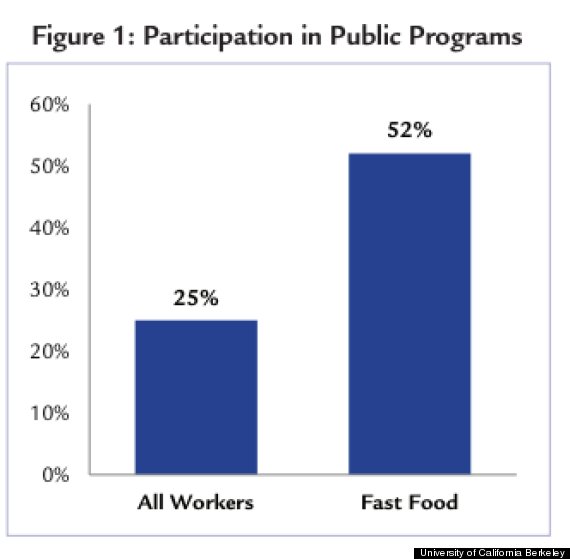
chartThe echoing numbers are simply a coincidence, but underscore the immense profits that the chain continues to pull in while its workers simply struggle to afford food, medical help and housing. The public assistance McDonald's workers receive comes via food stamps, welfare, Medicaid and other federal programs, according to the NELP report.
In a statement to The Huffington Post, McDonald's emphasized that workers get training and the opportunity for career advancement. The company also said that its franchisees pay competitive wages that are based on "local wage laws."
Those wages are stunningly low. Frontline fast-food workers make a median wage of $8.94 an hour, according to a recent Reuters report. "Fast-food workers work only 24 hours a week on average — at $8.94 an hour, this adds up to barely $11,000 a year," wrote Christine Owens for Reuters in August.
With wages that low, front-line fast food workers are more than twice as likely as the typical worker to participate in a government assistance program, according to the NELP report:
The National Restaurant Association, an industry trade group, last week labeled the NELP report...
[Click here to see the rest of this post]

Let’s get rid of (the term) entitlements

Is Workers' Compensation thought to be an "entltlement?" Today's post was shared by Steven Greenhouse and comes from www.washingtonpost.com

Let’s drop the whole notion of “entitlement.” Just eliminate it. Politicians, pundits and academics who talk about entitlements would then have to name the actual programs and argue their merits and demerits. This would encourage clarity and candor. Of course, that’s why it won’t happen. Generally, Americans don’t want clarity and candor in their fiscal debates. We blame our leaders for budget brawls — this latest was a doozy — but forget that our leaders are largely governed by public opinion, which is awash in contradictions.
So the government is “open” and the immediate threat of default has lifted. Great. But the political stalemate remains. Americans oppose excessive government spending and persistent deficits. Yet they also support the individual benefit programs (a.k.a. “entitlements”), led by Social Security, that drive spending and deficits.
Until the 1980s, entitlement wasn’t part of everyday language. Ronald Reagan was apparently the first president to use the term extensively. He may have “tired of getting beaten up every time he mentioned Social Security, and wanted a broader and more neutral term,” political scientist Norman Ornstein has suggested. Entitlement is a bland label. To say there’s an “entitlement problem” shrewdly avoids connecting it explicitly with popular programs. President Obama evasively speaks of entitlements in this way; so do most...
[Click here to see the rest of this post]

Snowden Offers to Fix Healthcare.gov

Do two negatives equal a positive? Today's post was shared by Steven Greenhouse and comes from www.newyorker.com

snowden-healthcare-580.jpeg

The N.S.A. leaker Edward Snowden today reached out to the United States government, offering to fix its troubled healthcare.gov Web site in exchange for immunity from prosecution.
Speaking from an undisclosed location in Russia, Mr. Snowden said he hacked the Web site over the weekend and thinks he is “pretty sure what the problem is.”
Look, this thing was built terribly,” he said. “It’s a government Web site, O.K.?”
Mr. Snowden said that if an immunity deal can be worked out, “I can get to work on this thing right away—I don’t need a password.”
In addition to full immunity, Mr. Snowden said he is requesting that he be allowed to work from home.
At the White House, President Obama offered a muted response to Mr. Snowden’s proposal: “Edward Snowden is a traitor who has compromised our national security. Having said that, if he knows why we keep getting those error messages, that could be a conversation.”
Get the Borowitz Report delivered to your inbox.Photograph: AP.
[Click here to see the original post]

Lousy Medicaid Arguments

Having technology that works is critical for operations and public confidence. Whether it be the PA court system or insurance exchanges, that need to work the first time around.Today's post was shared by Steven Greenhouse and comes from www.nytimes.com

For now, the big news about Obamacare is the debacle of HealthCare.gov, the Web portal through which Americans are supposed to buy insurance on the new health care exchanges. For now, at least, HealthCare.gov isn’t working for many users.
It’s important to realize, however, that this botch has nothing to do with the law’s substance, and will get fixed. After all, a number of states have successfully opened their own exchanges, doing for their residents exactly what the federal system is supposed to do everywhere else. Connecticut’s exchange is working fine, as is Kentucky’s. New York, after some early problems, seems to be getting there. So, a bit more slowly, does California.
In other words, the technical problems, while infuriating — heads should roll — will not, in the end, be the big story. The real threat remains the effort of conservative groups to sabotage reform, especially by blocking the expansion of Medicaid. This effort relies heavily on lobbying, lavishly bankrolled by the usual suspects, including the omnipresent Koch brothers. But it’s not just money: the right has also rolled out some really lousy arguments.
And I don’t just mean lousy as in “bad”; I also mean it in the original sense, “infested with lice.”
Before I get there, a word about something that, as far as we can tell, isn’t happening. Remember “rate shock”? A few months ago it was all the rage in...
[Click here to see the rest of this post]

BART strike could have long-term impact on unions

Today's post was shared by Steven Greenhouse and comes from www.sfgate.com

A few days before it all went down the tubes, Art Pulaski, executive secretary-treasurer of the California Labor Federation, had this to say on the organization's website:
"Whether BART closes down this week will come down to one issue and one issue only: whether the BART Board of Directors shows leadership or continues to act to hold Bay Area transit riders hostage by using the same playbook a small minority of elected officials in Washington, DC have used to close down our federal government."
BART riders and other denizens of the Bay Area so far haven't seen it that way. Quite the reverse: The unions are the hostage takers - a furious public has said so in overwhelming numbers. The unions are the ones who have closed down BART.
And, like the Republican Party in Washington, the unions appear to have suffered some serious damage. "The danger to labor is if the strike goes on for a while, then the unthinkable begins to be discussed - like banning all mass transit strikes," said Harley Shaiken, a labor economist at UC Berkeley.
That discussion has already begun, in letters from California lawmakers to Gov. Jerry Brown, from state Sen. Mark DeSaulnier, D-Concord, who said he "looking into legislation that could prevent future strikes," a petition drive by a Democratic Assembly candidate in the East Bay seeking the same, and a piece by editorial page editor John Diazin Sunday's Chronicle supporting a Republican proposal that BART unions be made to honor the no-strike clause in...
[Click here to see the rest of this post]

Kansas SC suspends former AG’s law license indefinitely | Legal Newsline

Today's post was shared by Legal Newsline and comes from legalnewsline.com

The Kansas Supreme Court has suspended former state Attorney General Phill Kline’s law license indefinitely.
The high court released its decision Friday.
Kline
“As fully detailed below, after reviewing each instance of misconduct found by the panel, we find clear and convincing evidence that Kline committed 11 (Kansas Rules of Professional Conduct) violations,” according to the court’s per curiam opinion.
“In assessing discipline, we have considered the facts and circumstances of each violation; the ethical duties violated by Kline to the public, the legal system, and the legal profession; the knowing nature of his misconduct; the injury that resulted from the misconduct; the existence of aggravating and mitigating factors; and the applicable advisory American Bar Association Standards for imposing discipline.
“Ultimately, after applying that framework, we reject the Disciplinary Administrator’s suggestion of disbarment and conclude Kline’s misconduct warrants indefinite suspension, the discipline recommended by the panel.”
In October 2011, a panel for the Kansas Board for Discipline of Attorneys recommended that Kline should have his state law license suspended indefinitely.
Kline served as the state’s top lawyer from 2003 to 2007, and as Johnson County District Attorney from 2007 to 2009.
The three-member panel pointed to Kline’s actions during investigations of abortion...
[Click here to see the rest of this post]

Facing lawsuits over deadly asbestos, paper giant launched secretive research program

By 2007, the Georgia-Pacific research program, approved by Childs, was in full swing. The first step was to try to re-create both wet and dry asbestos-containing joint compound since, Holm said in his deposition, no usable amounts of actual product could be located.
The re-created compound was applied to wallboard, allowed to dry and then sanded. The dust was shipped to a laboratory near Geneva, where Bernstein supervised a series of rat experiments. Lab workers wore “moon suits” to protect themselves from asbestos fibers.
In a pilot study, the rats were divided into three groups of 14 and confined in tubes for five days, six hours a day. The control group breathed filtered air. The second group breathed chrysotile fibers, the third a mixture of chrysotile and aerosolized joint compound particles.
The rats were killed after exposure and their lungs and pleural tissue were examined. The “chrysotile exposed lungs had the same appearance as the filtered-air controls,” Bernstein and his co-investigators reported. No obvious lung damage, in Bernstein’s view, translated to little or no cancer risk.
In a later experiment, one group of rats inhaled re-created Ready-Mix containing chrysotile. Another group inhaled amosite asbestos, part of the amphibole family. The rats exposed to chrysotile showed “no pathology in either the lung or the pleural cavity,” Holm testified in his deposition. Those that breathed amosite showed “both...
[Click here to see the rest of this post]

Monday, October 21, 2013

Your prescription history is their business

Drug history
Think you can keep a medical condition secret from life insurers by paying cash for prescription meds? Think again.

A for-profit service called ScriptCheck exists to rat you out regardless of how diligent you are in trying to keep a sensitive matter under wraps.
ScriptCheck, offered by ExamOne, a subsidiary of Quest Diagnostics, is yet another example of data mining — using sophisticated programs to scour databases in search of people's personal information and then selling that info to interested parties.

To be sure, life insurers have a need to know as much as possible about the people they cover. This helps mitigate risk and potentially keep rates affordable for everyone.

But for anyone who is taking an antidepressant, say, or being treated for a chronic condition, privacy can be a key consideration. You may not want employers — or potential employers — to know what you're taking. By the same token, you may not want to risk a potentially sharp increase in insurance premiums.

"It's a tough issue," said David Bryant, a Los Angeles life and health insurance broker. "From the consumer's perspective, you may want to keep certain things under wraps. But when you buy a policy, an insurer will want to pull all information about you."

And thanks to ScriptCheck, the insurer doesn't have to give things a second thought. By purchasing this or a similar service, the insurer can be notified of all prescriptions you've filled in recent years, regardless of how...
[Click here to see the rest of this post]

Computer woes plague Pa. worker comp system

Today's post was shared from philly.com.

New software was designed to modernize the process of filing claims. Instead, the opposite has happened, according to interviews with attorneys, judges and others who use the system.

The glitches range from being unable to upload claims or other supporting legal documents into the system to having court paperwork disappear.

The result: Injured workers and their lawyers have been unable to get hearings, creating a backlog of cases at the Labor and Industry Department's Bureau of Workers' Compensation.

Attorneys for workers, employers and insurance companies are, in some cases, not getting notified of decisions in their cases. And judges and their staff have even been unable to upload critical documents into the system.

"The intent was good, but the delivery has failed," said Philadelphia attorney Leonard A. Cohen, who represents injured workers and who is on a steering committee working with the state to oversee the implementation of the system. "We are all in favor of hanging in here. But in the meantime, the [new software] is causing the system to almost come to a halt."

The new system, designed by New York-based Deloitte Consulting LLC, went live on September 9 and the problems started immediately.

Cohen said he has filed 20 petitions on behalf of clients seeking workers' compensation since early September, and not one has been assigned to a...


[Click here to see the rest of this post]


The Future of Workers' Compensation

Congress has pushed the deadline for dealing with social issues and expenditures until after Election Day. That still leaves many issues including the future of Social Security and the delivery of medical benefits unaddressed. Those issues are closely intertwined with the patchwork of national programs called workers' compensation. Today's post was shared by Kaiser Health News and comes from www.kaiserhealthnews.org

The deal President Barack Obama, Republican and Democratic lawmakers reached to reopen the federal government and raise the debt ceiling includes a bipartisan panel charged with producing a long-term budget agreement.
Led by Senate Budget Committee Chairman Patty Murray, D-Wash., and House Budget Committee Chairman Paul Ryan, R-Wisc., the 29-member panel has a Dec. 13 deadline to reach consensus, a timeframe that seems optimistic considering the bitter partisan showdown over the health law that resulted in a 16-day government shutdown of the government and risked federal default.
In remarks Thursday, the president called for a new era of bipartisan cooperation on Capitol Hill. “To all my friends in Congress, understand that how business is done in this town has to change,” the president said. He noted that the nation’s fiscal challenges are the “long-term obligations that we have around things like Medicare and Social Security.  We want to make sure those are there for future generations. “
In a joint statement, Murray and Ryan pledged to work together to find a way around the automatic spending cuts known as “sequestration” now governing federal spending. “We hope we can reduce the deficit in a smarter way. We hope to restore stability to the budget process and end the lurching from crisis to crisis,” they said.
Medicare currently accounts for 16 percent of the federal budget, a share that will grow as more baby...
[Click here to see the rest of this post]

Exposure to Toxic Environmental Agents

The American College of Obstetricians and Gynecologists Committee on Health Care for Underserved Women
American Society for Reproductive Medicine Practice Committee
The University of California, San Francisco Program on Reproductive Health and the Environment

Committee OpinionThis Committee Opinion was developed by the American College of Obstetricians and Gynecologists Committee on Health Care for Underserved Women and the American Society for Reproductive Medicine Practice Committee with the assistance of the University of California, San Francisco (UCSF) Program on Reproductive Health and the Environment. The Program on Reproductive Health and the Environment endorses this document. This document reflects emerging clinical and scientific advances as of the date issued and is subject to change. This information should not be construed as dictating an exclusive course of treatment or procedure to be followed.
PDF Format
ABSTRACT: Reducing exposure to toxic environmental agents is a critical area of intervention for obstetricians, gynecologists, and other reproductive health care professionals. Patient exposure to toxic environmental chemicals and other stressors is ubiquitous, and preconception and prenatal exposure to toxic environmental agents can have a profound and lasting effect on reproductive health across the life course. Prenatal exposure to certain chemicals has been documented to increase the risk of cancer in childhood; adult male exposure to pesticides is linked to altered semen...
[Click here to see the rest of this post]

Flavorings and Fragrances: A Newly Engineered Problem in the Workplace

Flavorings and fragrances have ben a perennial problem in the workplace. They have created and contributed to occupational exposures and diseases. Some exposure have led to civil lawsuits, beyond workers' compensation claims. Today's post is shared from nytimes.org

Vanilla, saffron, patchouli. For centuries, spices and flavorings like these have come from exotic plants growing in remote places like the jungles of Mexico or the terraced hillsides of Madagascar. Some were highly prized along ancient trading routes like the Silk Road.

Now a powerful form of genetic engineering could revolutionize the production of some of the most sought-after flavors and fragrances. Rather than being extracted from plants, they are being made by genetically modified yeast or other micro-organisms cultured in huge industrial vats.

“It’s just like brewing beer, but rather than spit out alcohol, the yeast spits out these products,” said Jay D. Keasling, a co-founder of Amyris, a company based here that is a pioneer in the field. However, while yeast makes alcohol naturally, it would not produce the spices without the extensive genetic rejiggering, which is called synthetic biology.

The advent of synthetic biology raises thorny economic and regulatory issues, such as whether such yeast-made ingredients can be called natural and whether developing countries dependent on these crops will be hurt.

Supporters say the technique could benefit food and cosmetic companies, and...
[Click here to see the rest of this post]

….

Jon L. Gelman of Wayne NJ is the author NJ Workers’ Compensation Law (West-Thompson) and co-author of the national treatise, Modern Workers’ Compensation Law (West-Thompson). For over 4 decades the Law Offices of Jon L Gelman  1.973.696.7900  jon@gelmans.com  have been representing injured workers and their families who have suffered occupational accidents and illnesses.