McDonald's announced Monday that it raked in $1.5 billion in profits in the third quarter, up 5 percent from last year.
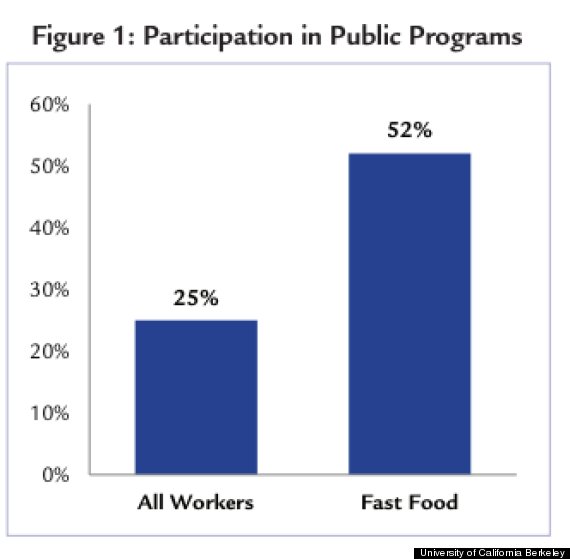
The number is strikingly close to the $1.2 billion taxpayers are shelling out each year to help pay public assistance to the McDonald's workforce, according to a report released last week by the National Employment Law Project. In a statement to The Huffington Post, McDonald's emphasized that workers get training and the opportunity for career advancement. The company also said that its franchisees pay competitive wages that are based on "local wage laws." Those wages are stunningly low. Frontline fast-food workers make a median wage of $8.94 an hour, according to a recent Reuters report. "Fast-food workers work only 24 hours a week on average — at $8.94 an hour, this adds up to barely $11,000 a year," wrote Christine Owens for Reuters in August. With wages that low, front-line fast food workers are more than twice as likely as the typical worker to participate in a government assistance program, according to the NELP report: |
A for-profit service called ScriptCheck exists to rat you out regardless of how diligent you are in trying to keep a sensitive matter under wraps.
ScriptCheck, offered by ExamOne, a subsidiary of Quest Diagnostics, is yet another example of data mining — using sophisticated programs to scour databases in search of people's personal information and then selling that info to interested parties.
To be sure, life insurers have a need to know as much as possible about the people they cover. This helps mitigate risk and potentially keep rates affordable for everyone.
But for anyone who is taking an antidepressant, say, or being treated for a chronic condition, privacy can be a key consideration. You may not want employers — or potential employers — to know what you're taking. By the same token, you may not want to risk a potentially sharp increase in insurance premiums.
"It's a tough issue," said David Bryant, a Los Angeles life and health insurance broker. "From the consumer's perspective, you may want to keep certain things under wraps. But when you buy a policy, an insurer will want to pull all information about you."
And thanks to ScriptCheck, the insurer doesn't have to give things a second thought. By purchasing this or a similar service, the insurer can be notified of all prescriptions you've filled in recent years, regardless of how...
ScriptCheck, offered by ExamOne, a subsidiary of Quest Diagnostics, is yet another example of data mining — using sophisticated programs to scour databases in search of people's personal information and then selling that info to interested parties.
To be sure, life insurers have a need to know as much as possible about the people they cover. This helps mitigate risk and potentially keep rates affordable for everyone.
But for anyone who is taking an antidepressant, say, or being treated for a chronic condition, privacy can be a key consideration. You may not want employers — or potential employers — to know what you're taking. By the same token, you may not want to risk a potentially sharp increase in insurance premiums.
"It's a tough issue," said David Bryant, a Los Angeles life and health insurance broker. "From the consumer's perspective, you may want to keep certain things under wraps. But when you buy a policy, an insurer will want to pull all information about you."
And thanks to ScriptCheck, the insurer doesn't have to give things a second thought. By purchasing this or a similar service, the insurer can be notified of all prescriptions you've filled in recent years, regardless of how...
