Copyright

(c) 2010-2026 Jon L Gelman, All Rights Reserved.

Saturday, September 28, 2013

Workers ask President Obama to raise their wages

Today's post was shared by Steven Greenhouse and comes from america.aljazeera.com


President Obama has also shown sympathy for the issues of low-wage workers, although the minimum wage increase he's expressly supported -- to $9 an hour -- is still less than what activists usually consider a "living wage."
"I think the president's heart in the right place," Ellison said. "We’ve just got to get his pen on the right place."
Federal contractors employ over a fifth of the American civilian workforce, and more than 560,000 of these workers earn $12 or less an hour, according to Demos, a liberal think tank. Many of them are cleaners and concession workers in federal buildings. If you include all the low-wage jobs funded by public dollars, including the 1.2 million paychecks underwritten by Medicare and Medicaid, the total, Demos found, surpasses the low-wage workforce of Walmart and McDonald’s combined.
Labor group Good Jobs Nation, backed by the Service Employees International Union, organized three smaller building-specific strikes earlier this year, as well as a city-wide labor action in May. It’s part of a larger strategy by unions and labor activists to push for higher wages in the largely non-unionized workforces of retail and fast food. Organizers called Wednesday's event the largest low-wage federal worker strike to date. Both Ellison and Sen. Bernie Sanders (I-Vt.) gave passionate speeches at the event.
[Click here to see the original post]

Bangladesh Deploys Paramilitary in Garment Zone After Protests

International Fashion Safety is becoming an international catalyst for change. Today's post was shared by Steven Greenhouse and comes from www.bloomberg.com


Bangladesh’s government deployedparamilitary troops in the industrial belt of Gazipur to deterfurther protests as garment factories reopened after five daysof violent demonstrations.
“The situation is now relatively calm,” MostafijurRahman, additional superintendent of police for Gazipurdistrict, said in a phone interview. Television footage showedthe troops patrolling streets where workers attacked factoriesand blocked traffic earlier this week to demand wage increases.
The government is acting after factory owners met HomeMinister Muhiuddin Khan Alamgir yesterday to urge tightersecurity. Thousands of garment workers clashed with police thisweek in the industrial belt on the outskirts of Dhaka, forcingabout 400 factories that supply companies such as Wal-MartStores Inc. to close.
“Unrest in the garment sector will be firmly dealt with,”the minister told reporters, after the meeting.
The labor unrest came five months after the collapse of theeight-story Rana Plaza factory complex killed more than 1,000people in the worst industrial accident in the South Asiancountry’s history. Low wages and production costs have helpedspawn the country’s $19 billion manufacturing industry thatsupplies global retailers with cheap clothes.
The protestors, some of whom pelted factories with bricksand blocked a highway, demanded a minimum monthly salary of8,114 taka ($104), up from 3,000 taka now. Retailers such asWal-Mart, Inditex SA, Gap Inc. and ...
[Click here to see the rest of this post]

Building an Accountable Care Organization and Its Impact on Workers' Compensation

Medical cost containment is a universal problem for insurance companies and employers. For those states with fee schedules indexed to the Medicare system, limitations are in place. For those jurisdiction where fee limitations are not in place, ie. NJ,costs may continue to soar without containment. Today's post was shared by NEJM and comes from blogs.hbr.org

Suppose for a moment that you are an administrator in an organization that provides health care and your job is on the line for delivering both savings and improved care. Because you want to be part of the solution to the health-care-cost problem, you have signed contracts with payers that reward your institution or system for reducing the costs of care. These same contracts require you to pay a penalty if the costs of care go up more than inflation. What would be your first, second, and third move?

This is not a hypothetical question. More than 300 hundred administrators of accountable care organizations (ACOs) across the United States are facing it.

My team at Partners HealthCare in Boston is faced with this exciting (and daunting) challenge. Having signed shared-savings contracts with both commercial payers and Medicare, our CEO, Gary Gottlieb, established a Population Health Management unit. A major focus of our work is to achieve shared savings in our contracts. That means controlling costs for the populations cared for by our primary care physicians. Since doctors and hospitals within Partners bill for a majority of the care these patients receive, you could say our success depends on reducing the income of our colleagues. Harvard Business School’s Clayton Christensen has taught us this is not possible — that an organization will not cannibalize itself.

So when we go knocking on...
[Click here to see the rest of this post]

Friday, September 27, 2013

The Impact and Echoes of the Wal-Mart Discrimination Case

This article is shared from propublica.

The post is shared from probulica.org.

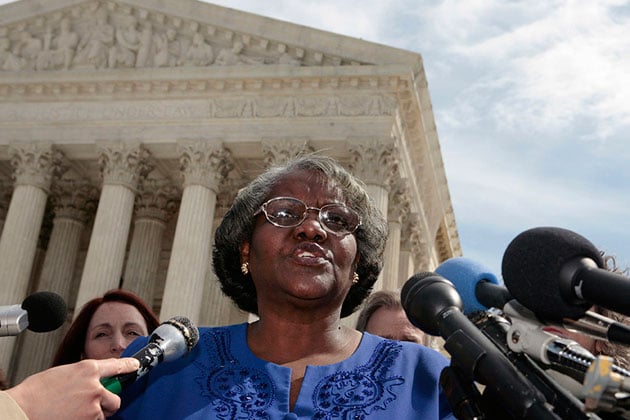
Betty Dukes talks to the press on the steps of the U.S. Supreme Court after the class action lawsuit Dukes v. Wal-Mart was argued before the court in Washington, March 29, 2011
(Photo: Reuters)
When the U.S. Supreme Court issued its 5-4 decision in Wal-Mart v. Dukes in June 2011, no one needed a Richter scale to know it was a Big One. In throwing out a mammoth lawsuit by women employees who claimed that they’d been systematically underpaid and underpromoted by the world’s biggest corporation, the ruling upended decades of employment discrimination law and raised serious barriers to future large-scale discrimination cases of every kind.

Employers rejoiced. Others predicted serious setbacks for women and minorities, especially in employment discrimination cases brought under Title VII of the Civil Rights Act of 1964. That landmark law had opened the way to the use of the class-action lawsuit as a potent weapon for people who could not stand up for their rights on their own.
Two years later, it’s becoming clear just how much the ruling has reshaped the American legal landscape.

The Dukes decision has already been cited more than 1,200 times in rulings by federal and state courts, a figure seen by experts as remarkable. Jury verdicts have been overturned, settlements thrown out, and class actions rejected or decertified, in many instances undoing years of litigation. The rulings have come in every part of the country, in lawsuits involving all types of companies,...
[Click here to see the rest of this post]

ARE YOU OVEREXPOSING YOURSELF IN SOCIAL MEDIA?

Today's post comes from guest author Laurel Anderson, from Causey Law Firm.
By Laurel Anderson from Causey Law Firm
     Facebook, Twitter, YouTube, LinkedIn, Pinterest, Instagram and other wildly popular social media websites have transformed how people both connect with each other and obtain information about other people. It has also created a change in the legal arena. For our clients who are currently applying for or receiving workers’ comp time loss benefits, or Social Security Disability Insurance (SSDI) benefits, our advice is to keep in mind the importance of privacy settings for both written information and photos on their individual accounts. While a Washington State law went into effect this weekend barring employers from requesting access to Facebook passwords, if your privacy settings are not tight, curious parties can randomly obtain information about you.
While a Washington State law went into effect this weekend barring employers from requesting access to Facebook passwords, if your privacy settings are not tight, curious parties can randomly obtain information about you.
     From our experience, you can now assume that claims managers, employers, and defense attorneys will search for information on the internet regarding your personal life that can impact your claim for benefits. Please make sure that any outdated information regarding your activities is removed from your personal page. Do not use social media to vent about your employer or state agencies that are the decision-makers in your claim. You may be under the impression that only your friends can see your personal page, and that you have some right to privacy. However, be aware that all of the content on your walls, including photos and instant messaging, could be potentially discoverable by your employer or opposing counsel in a litigated case if the content is relevant to your claim for benefits.
     The risk is somewhat less in the SSDI arena since there actually is an agency directive to ALJs and DDS adjudicators that they are not to use social media to research claimants. We nevertheless warn our SSDI clients concerning social media, as we are not convinced that agency people are always playing by the rules, or that those rules may not soon change.
Photo credit: lindes / Foter / CC BY-NC-SA

Antibiotic Resistant Threats in the US, 2013

Healthcare workers have something to worry about. Today's post is shared from the US CDC.

Threat Report 2013

This report, Antibiotic resistance threats in the United States, 2013 gives a first-ever snapshot of the burden and threats posed by the antibiotic-resistant germs having the most impact on human health
Each year in the United States, at least 2 million people become infected with bacteria that are resistant to antibiotics and at least 23,000 people die each year as a direct result of these infections. Many more people die from other conditions that were complicated by an antibiotic-resistant infection.
Antibiotic-resistant infections can happen anywhere. Data show that most happen in the general community; however, most deaths related to antibiotic resistance happen in healthcare settings such as hospitals and nursing homes.

OSHA cites Nebraska Cold Storage for 14 safety violations including ammonia exposure

Proposed fines total $132,800; company placed in Severe Violator Enforcement Program

Nebraska Cold Storage Inc. has been cited for 14 safety violations and fined $132,800 by the U.S. Department of Labor's Occupational Safety and Health Administration for exposing workers to anhydrous ammonia at its Hastings facility. The company has been placed in OSHA's Severe Violator Enforcement Program.

"Ammonia is considered a high health hazard because it can be corrosive to the skin, eyes and lungs. It is flammable at varying concentrations," said Bonita Winingham, OSHA's area director in Omaha. "Businesses that handle hazardous materials must take precautions to protect workers from exposure to chemicals, explosions and fire hazards."

The March inspection was initially conducted under OSHA's high-hazard local emphasis program. It expanded to include all items within the agency's national emphasis program for process safety management for covered chemical facilities. The company provides basic storage and shipping services for the frozen, refrigerated and perishable food industries.

Four willful violations were cited. Some involve PSM violations, including the failure to develop and implement written, safe operating and mechanical integrity procedures and measures to take for physical contact or airborne exposure to anhydrous ammonia. The remaining violations involve failing to correct deficiencies in equipment and to document responses to 2010 compliance audit findings, including 12 of 22 deficient audit items that remained uncorrected. A willful violation is one committed with intentional, knowing or voluntary disregard for, or plain indifference to, employee safety and health.

A total of 10 serious safety violations include lack of emergency action planning; failing to maintain the original ammonia refrigeration systems process hazard analysis; exposing workers to crushing hazards by failing to remove and/or repair damaged storage racks; and failing to evaluate the performance of a powered industrial truck operator every three years. The other violations include failing to prevent electrocution from ice buildup encasing electrical junction boxes; operating equipment within 30 inches of a fork truck charging station; and install fixed wiring and provide strain relief for power cords. A serious violation occurs when there is substantial probability that death or serious physical harm could result from a hazard about which the employer knew or should have known. The current citations may be viewed at http://www.osha.gov/ooc/citations/Nebraska_Cold_Storage.pdf*

OSHA's Severe Violator Enforcement Program focuses on recalcitrant employers that endanger workers by committing willful, repeat or failure-to-abate violations. Under the program, OSHA may inspect any of the employer's facilities if it has reasonable grounds to believe there are similar violations.

The company has 15 business days from receipt of the citations and notice of proposed penalties to contest the citations and proposed penalties before the independent Occupational Safety and Health Review Commission. If a company does not file or contest within that period, it must abate the cited conditions within the period ordered in the citations and pay the proposed penalties.

Mets’ Harvey Is Covered Like Any Other Employee With a Workplace Injury

Today's post  comes from www.nytimes.com


If Mets pitcher Matt Harvey has Tommy John surgery on his right elbow, it will be paid for, partly, with workers’ compensation insurance. A partly torn ulnar collateral ligament like Harvey’s is considered a workplace injury, just as if he were a truck driver hurt on a loading dock.
The basic agreement between major league owners and players requires that teams pay the cost of injuries.

“The employer gets to recover, as an offset, any workers’ compensation recovery that is available,” said Rob Manfred, an executive vice president of Major League Baseball. “And the club is on the hook for what workers’ compensation doesn’t pay.”

At some point after an operation or procedure, a player signs a form that allows his team to pursue the insurance claim. So if workers’ compensation did not pay the full cost of Derek Jeter’s surgery for a fractured left ankle last year, the Yankees made up the difference — essentially the cost of doing business.

“The player never sees a bill,” Manfred said.

Another factor is that the cost of Tommy John surgery is not uniform. Dr. James Andrews, the renowned orthopedic surgeon, might charge more than the Hospital for Special Surgery, where the Mets’ medical director, David Altchek, is an orthopedic surgeon. (Andrews prescribed a six- to eight-week rehabilitation program for Harvey earlier this week that would precede any decision to operate.)

Altchek...

[Click here to see the rest of this post]

Some players may be out of NFL deal

Today's post was shared by CAAA and comes from espn.go.com


NFL Concussion Settlement Details
New details from the NFL's $765 million proposed concussion settlement reveal that the first players diagnosed with football-related brain damage would be shut out of the deal. And with the number of confirmed brain damage cases growing, some players and attorneys told "Outside the Lines" they fear there isn't enough money to cover all eligible players diagnosed with such injuries.

Former players report widespread confusion over who will qualify for compensation and how the money will be distributed. Details described to "Outside the Lines" by sources familiar with the settlement -- along with new statistics on the incidence of football-related brain damage -- underscore the concerns voiced by some players and lawyers:

• The proposed settlement disqualifies most players who died before 2006, even if they were diagnosed with football-related brain damage. That would shut out the relatives of players like Hall of Fame Pittsburgh Steelers center Mike Webster, who died in 2002 and was later diagnosed with the first case of football-related brain damage. Webster's protracted battle with the NFL raised public awareness and helped ignite the NFL's concussion crisis.

A source familiar with the negotiations said the NFL sought to include only death claims that fell within the statute of limitations -- two years in most states. That would have cut out many players who died before 2009 and 2010. As part of the negotiations, representatives of the...
[Click here to see the rest of this post]

United Airlines flight lands safely after pilot suffers heart attack

Safety in the air is of great concern.What is lacking is adequate access to medical care and resources on an urgent basis. This article is shared from Reuters.

A United Airlines flight bound for Seattle with 165 people on board made an emergency landing at Boise Airport on Thursday evening after the pilot suffered a heart attack, an airport spokeswoman said.
The Boeing 737 landed safely shortly after 8 p.m. local time and the pilot was rushed to a local hospital, where his condition was unknown, Boise Airport spokeswoman Patty Miller said.
"We got a call from United flight 1607 at about 7:55 p.m. Mountain Time declaring an emergency, they said the pilot had had a heart attack," Miller said, adding that the plane landed at 8:08 p.m.
Click here to read the complete article.
[Click here to see the rest of this post]

EPA Announces the start of Sampling Activities at the CTS of Ashville, Inc. Superfund Site in Ashville,North Carolina

September 20, 2013) Today, US Environmental Protection Agency (EPA) officials announced sampling activities for the Soil Vapor Extraction (SVE) Confirmation Sampling and Analysis Plan and the Non-Aqueous Phase Liquids (NAPL) Investigation will begin on Monday, September 23, 2013 at the CTS of Ashville Inc. Superfund Site in Ashville, NC

The work will include collecting soil and water samples to better understand how deep and wide the highest concentrated contamination exists on and adjacent to the former plant property.

The NAPL Work Plan requires that samples also be collected on adjacent properties to the east of the Site, and if data indicates the need sampling may proceed to properties on the west of the Site. Specialized equipment will be used and the sampling area may be expanded as data is collected. This work is essential to determine the best cleanup plan for the Site.

The sampling event is projected to take about 3 months. EPA and/or its contractor will provide oversight of the sampling activities.

Lobbying In D.C. On Behalf Of Injured Workers


Regulations were proposed recently to operationalize the The SMART act. The public comment period is ongoing. Today's post comes from guest author Paul J. McAndrew, Jr., from Paul McAndrew Law Firm.

On April 17, my colleagues from WILG (Workers Injury Law & Advocacy Group) and I gathered in Washington D.C. to lobby Congressional representatives on behalf of injured workers. We discussed several bills that will affect the interests of workers in Iowa and across the United States. I had the pleasure of meeting with Senator Tom Harkin, Senator Chuck Grassley, Congressman Bruce Braley and Congressman Dave Loebsack in their offices where we discussed the following bills:

The MSP and Workers’ Compensation Settlement Agreement Act of 2012

The Akaka Amendment to S. 1789, The Post Service Reform Bill (an amendment to strip from S. 1789 those provisions that deform the Federal Employee Compensation Act).


As I explained at these meetings, the MSP and Worker’s Compensation Settlement Act of 2012 is necessary for three reasons:
(1) to bring some reasonable and understandable system to CMS’ current uncertain and regulation-less system of establishing Medicare Set-aside Plans for workers’ compensation settlements;
(2) to allow for an appeal of CMS’s MSA determination; and
(3) to bring some reasonable time limits to CMS’ process of setting the MSA required for workers’ compensation settlements.

The Akaka Amendment to strip the FECA deform provisions out of S.1789 is necessary because the FECA deform provisions wrongfully reduces monetary benefits and treats the injured worker like a fraud (mandating period independent medical examinations, vocational rehabilitation and field nurses to hound the injured worker). Workers' compensation reform is a constant threat to the rights of workers across the country. It is important that all of us who participate in the work' comp' system do our part to protect and preserve these legal rights.
Tembow

The High Price of Gas – Mileage Reimbursement for Injured Workers

Some states like NJ offer zero mileage reimbursement. Today's post comes from guest author Laurel Anderson, from Causey Law Firm.
By Laurel Anderson from Causey Law Firm
     Injured workers who are are dependent on time loss compensation payments of only 60-75% of their wages unfortunately are well used to the enormous financial losses and constraints this wage loss puts on their family budgets.  With budget cuts being made by the Department of Labor & Industries which place additional burdens on workers by reducing reimbursements for the additional costs incurred as a result of an injury, it is important to be aware of what you can be reimbursed for, and what some relatively new regulations do not cover.  The current mileage reimbursement rate is now 56.5 cents per mile.
When money is tight, making sure you receive everything you are entitled to under your claim is important!
     Injured workers are always entitled to receive travel and/or wage reimbursement if they are asked to attend an IME (Independent Medical Exam).  However, we have noted that more recently both the Department and self-insured employers are failing to provide workers with the form necessary to be reimbursed gas mileage for what are often not insignificant distances.   Many workers are unaware they can have their wages reimbursed as well if they miss time from work.  The form can be found online here.  When self-insured employers do not provide our clients with a reimbursement form when sending out IME notices, we will send out the Department’s standard form.
     More difficult to decipher are the rules allowing for travel reimbursement for medical treatment or vocational services.  A different form must be filed to obtain reimbursement for these expenses.  At Causey Law Firm, we insure that our clients are reimbursed for travel for vocational meetings which take place in our office.  Parking is expensive in Seattle, and that cost can be reimbursed to you directly.  Some law firms charge a fee on travel reimbursement expenses, but we do not.
     While injured workers have the right to treat with their own preferred provider, travel reimbursement is only paid for regular treatment visits if there is no adequate treatment provider within 15 miles of their home AND if the claims manager has pre-authorized the travel.  Travel reimbursement is now limited for regular medical treatment visits by the so-called “15 mile rule”.  Thus, if your pre-authorized provider is 30 miles from your home, reimbursement will only be provided for the last 15 miles each way of that trip.  As with medical appointments, regular visits to meet with a vocational counselor are only covered after that 15 mile threshold has been reached.  If you are approved for a formal vocational retraining plan, however, mileage may be fully reimbursable through your plan with necessary signatures and paperwork submitted through a vocational rehabilitation counselor.
      Many workers are unaware of their right to apply for reimbursements, which can be submitted to the Department for a period up to one year of the date of travel.  The Department’s general guidelines can be seenhere.  When money is tight, making sure you receive everything you are entitled to under your claim is important!

OCCUPATIONAL VIOLENCE

Today's post was shared by Safe Healthy Workers and comes from www.cdc.gov

Violence on the Job - image of shattered glass

The magnitude of workplace violence in the United States is measured with fatal and nonfatal statistics from several sources. The Bureau of Labor Statistics’ Census of Fatal Occupational Injuries (CFOI) reported 13,827 workplace homicide victims between 1992 and 2010. Averaging over 700 homicides per year, the largest number of homicides in one year (n=1080) occurred in 1994, while the lowest number (n=518) occurred in 2010.

From 2003 to 2010 over half of the workplace homicides occurred within three occupation classifications: sales and related occupations (28%), protective service occupations (17%), and transportation and material moving occupations (13%).

The Bureau of Labor Statistics Survey of Occupational Injuries and Illnesses (SOII) reported an estimated 130,290 nonfatal occupational injuries and illnesses involving days away from work during the 2003 to 2010 time period. The Healthcare and Social Assistance Industry accounted for 63% of these injuries and illnesses each year.

Data collected by the Consumer Product Safety Commissions’ National Electronic Injury Surveillance System (NEISS) that is collected in collaboration with NIOSH (NEISS-Work Supplement) estimated more than 137,000 workers were treated in emergency departments for nonfatal assaults in 2009.

The Bureau of Justice StatisticsNational Crime Victimization Survey (NCVS) estimated the number of nonfatal violent crimes occurring against persons 16 or older while they were at...
[Click here to see the rest of this post]

Thursday, September 26, 2013

AIG CEO: Anger over AIG bonuses ‘just as bad’ as lynchings

Today's post was shared by Steven Greenhouse and comes from m.washingtonpost.com

Robert Benmosche (Bloomberg News)

AIG's CEO Robert Benmosche -- who came in to rescue the company after the 2008 financial crisis -- told the Wall Street Journal that the outrage over the bonuses promised to AIG's members was just as bad as when white supremacists in the American South used to lynch African Americans:
The uproar over bonuses "was intended to stir public anger, to get everybody out there with their pitchforks and their hangman nooses, and all that -- sort of like what we did in the Deep South [decades ago]. And I think it was just as bad and just as wrong."
Yes, enduring some public criticism for receiving multimillion-dollar bonuses after helping crash the global economy is a lot like being hanged from a tree by your neck until you die.
These kinds of sentiments don't emerge in a vacuum. Benmosche is expressing a view that was pretty common back in 2010 and 2011, when it was kind of a thing for members of the besieged 1 percent to compare public anger over their compensation to the way Nazi Germany treated the weak. There was supermarket mogul John Catsimatidis:
"Taxes are going to go up regardless. What I'm afraid of is, we shouldn't punish any one group. Whether we're punishing people who are wealthy," he said. "New York is for everybody; it's for the poor, it's for the middle-class, it's for the wealthy. We can't punish any one group and chase them away. We - I mean, Hitler punished the Jews. We can't have punishing the '2 percent group' right now."
...
[Click here to see the rest of this post]

Exclusivity Rule: Court Holds Risk of Death Contemplated by Legislature

A NJ Appellate Court has ruled that the Exclusivity Bar prohibits the estate of a fatally injured trash truck driver from proceeding with an intentional tort claim against his employer. Even though the employer may have defeated the neutral safety switch and was cited for violations by OSHA, the Court ruled that the industry risk of being fatally injured was contemplated by the Legislature when promulgating the NJ Workers' Compensation Act.

Sellino v Pinto Brothers Disposal, Docket No. A-2064-12T1, 2013 WL 5300076 (Decided: September 23, 2013)

….

Jon L. Gelman of Wayne NJ is the author NJ Workers’ Compensation Law (West-Thompson) and co-author of the national treatise, Modern Workers’ Compensation Law (West-Thompson). For over 4 decades the Law Offices of Jon L Gelman  1.973.696.7900  jon@gelmans.com  have been representing injured workers and their families who have suffered occupational accidents and illnesses.


NJ Workers' Compensation Maximum Rate Rising in 2014

The maximum NJ Workers' Compensation is proposed to rise to $843.00 per week in 2014.  The rate is based upon the State's Average Weekly Wage (SAWW). The rate applies to temporary disability, permanent disability, permanent total, permanent partial total, and dependency benefits.
The rate for 2013 is $826.00.

NJAC 12:235-1.6 (September 3, 2013)
2013 NJ REG TEXT 335666