For years, the debate over restricting the stew of industrial chemicals that we live in has suffered from a case of he said, she said. Environmental groups sounded the alarm about the thousands of chemicals in our air, water, food, housewares, and shampoo that science suggests — but doesn’t outright prove — could make us sick. They warned about such commonly used substances as BPA (in cans and plastics), fire retardants (in furniture), and phthalates (in cosmetics). Chemical industry representatives countered that there is no clear evidence that their products are unsafe, and tighter regulation would squash innovation. But now it’s about pregnant moms and unborn babies. For the first time ever, the American Congress of Obstetricians and Gynecologists (ACOG) this week came out with a strong statement about the risks of environmental toxins to pregnant women and fetuses. Also for the first time, the group is going so far as to urge individual doctors to advocate for policy changes to protect women and babies from exposure. “The scientific evidence over the last 15 years shows that exposure to toxic environmental agents before conception and during pregnancy can have significant and long-lasting effects on reproductive health,” wrote ACOG. Another group of reproduction specialists, the American Society... |
Copyright
(c) 2010-2026 Jon L Gelman, All Rights Reserved.
Tuesday, October 1, 2013
An Official Statement on Environmental Toxins and Pregnancy
Bill Creating Clear Guidelines in Dispensing of Opiod Medications Introduced in New Jersey Senate
| The post today is authored by John H. Geaney, Esq. of the NJ Bar, and is shared via njworkerscompblog.com Opioid medications have become a major problem in the New Jersey workers’ compensation system. The number of workers being prescribed opioids has increased dramatically along with other attendant problems, such as addictions to the medications, excessive periods of use, and large numbers of unused opioid pills due to over-prescribing. Every workers’ compensation professional can attest to these and other problems with opioid medications, not to mention cases where urine testing shows no trace of opioids in the system despite repeated renewals of opioid prescriptions. On September 30, 2013, Senator Raymond Lesniak and Senator Stephen Sweeney introduced a bill in the New Jersey Senate proposing that medical expenses shall not include coverage of opioid drugs unless the prescribing doctor does the following: 1) takes a thorough medical history and physical examination focusing on the cause of the patient’s pain; 2) does a complete assessment of the potential addiction of the patient to opioids, which would include a baseline urine test and assessment of past and current depression, anxiety disorders and other mood disorders associated with risk of opioid abuse; 3) provides a written treatment plan with measurable objectives, a list of all medications being taken and dosages, a justification for the continued use of opioid... |
Related articles
- Senate fails to revive workers' comp bill for first responders (workers-compensation.blogspot.com)
- What If I May Need Surgery Later? (workers-compensation.blogspot.com)
- Mets' Harvey Is Covered Like Any Other Employee With a Workplace Injury (workers-compensation.blogspot.com)
- Who Is Paying the Bills for Occupational Illnesses and Disease? (workers-compensation.blogspot.com)
- Bill limiting workers' comp claims by athletes is sent to governor (workers-compensation.blogspot.com)
- Workers' Compensation Task Force meets (workers-compensation.blogspot.com)
- What Does That Stand For? Commonly Used Acronyms in Workers' Compensation Cases (workers-compensation.blogspot.com)
Monday, September 30, 2013
Oklahoma: Gov. Fallin's picks for workers comp commission lack experience
Today's post is shared from Tulsworld.com
[Click here to see the rest of this post]

Gov. Mary Fallin's first two appointments to the state's new workers compensation system have no experience in workers compensation law. And that's OK, says Fallin spokesman Alex Weintz. "As a manager and a business leader, Troy Wilson is acutely aware of how workers compensation affects businesses," said Weintz. "As the former director of the Department of Commerce, Jonna Kirschner knows what an obstacle workers comp costs can be to businesses looking to locate here." Wilson, named by Fallin to be the first chairman of the new Workers Compensation Commission, and Kirschner, who is expected to be one of the commission's first administrative law judges, get high marks all around for integrity and general ability. But the enabling legislation creating the new system specifies that commissioners "must have been involved in the workers compensation field for at least three years." Judges, the law says, "shall have not less than three years of workers compensation experience prior to appointment." Wilson is a retired banker, businessman and Xerox executive who was retired comfortably in Florida at the time of his appointment. Kirschner is an attorney who specialized in corporate law before joining the Commerce Department. She is also the daughter of state Supreme Court Justice Yvonne Kauger, which could complicate the court's consideration of a lawsuit challenging the new system's constitutionality. Weintz said questioning Wilson's... |
Related articles
- Work Comp Steps Up to ACA (workers-compensation.blogspot.com)
- Bill limiting workers' comp claims by athletes is sent to governor (workers-compensation.blogspot.com)
- Questionable Workers Comp Claims Report: Fewer Claims and More Disputes (workers-compensation.blogspot.com)
- Legislators consider workers' comp changes (workers-compensation.blogspot.com)
- What Does That Stand For? Commonly Used Acronyms in Workers' Compensation Cases (workers-compensation.blogspot.com)
- Oklahoma Work Comp Opt-Out System Under Legal Attack (workers-compensation.blogspot.com)
Will history of health hazards be repeated at new Wisconsin iron mine?
| Today's post was shared from The Pump Handle.... The long-time residents of Iron County, Wisconsin who make up the Iron County Joint Impacts Mining Committee say the open-pit iron mine planned for the Penokee Hills of northern Wisconsin – a range that extends into Michigan where it’s known as the Gogebic Range – will bring much needed good jobs and economic development. Such jobs, the committee told a group of visiting journalists in August, have been lacking since the last Wisconsin iron mines in the area closed in the early and mid-1960s. The jobs the mine would bring are the type needed to keep local communities’ young people from moving away, said committee members. Environmental advocates and other area residents, including many of the region’s tribal leaders, oppose the mine for what they say will be devastating impacts, particularly to the area’s waterways and wetlands. The proposed mine made national news this summer after masked activists harassed mining company personnel and armed security guards were hired to patrol the property. There’s also been considerable controversy over a new law that was passed that will help facilitate the mine. What have not yet received much attention are the potential occupational health hazards of mining and processing the taconite ore the mine is expected to yield. Now in the permitting and exploratory stage of development by Gogebic Taconite LLC – a subsidiary of a company called Foresight Energy that has coal mining operations in... |
Related articles
- Wisconsin High-Risk Insurance Program Closing Down (workers-compensation.blogspot.com)
- Poor Diet Of Shift Workers An "Occupational Health Hazard" (workers-compensation.blogspot.com)
- Legislators consider workers' comp changes (workers-compensation.blogspot.com)
- OSHA cites Nebraska Cold Storage for 14 safety violations including ammonia exposure (workers-compensation.blogspot.com)
- A very particular crime - Hazards magazine (workers-compensation.blogspot.com)
- EPA Web Tool Expands Access to Scientific, Regulatory Information on Chemicals (workers-compensation.blogspot.com)
- Work Comp Steps Up to ACA (workers-compensation.blogspot.com)
Open for Business Tomorrow: Healthcare.gov
Tomorrow marks an historic day in US history. The Federal government launches insurance enrollment under The Affordable Care Act.
Visit Healthcare.gov for further information.
Related articles
- World Trade Center Health Program; Addition of Prostate Cancer to the List of WTC-Related Health Conditions (workers-compensation.blogspot.com)
- Improving Patient and Worker Safety: Opportunities for Synergy, Collaboration and Innovation (workers-compensation.blogspot.com)
- Needlestick Injuries Are a Costly Problem for the Health Care Industry (workers-compensation.blogspot.com)
- Has the Internet Raised or Lowered Healthcare Costs? (workers-compensation.blogspot.com)
- Rules to improve employment of people with disabilities and veterans published today (workers-compensation.blogspot.com)
Sunday, September 29, 2013
BP Trial in 2nd Phase, to Set Amount of Oil Spilled
Post shared from the nytimes.com.
[Click here to see the rest of this post]

With billions of dollars in penalties at stake, the civil trial of the British oil company BP begins its second phase on Monday, which will set the amount of oil that spilled into the Gulf of Mexico from the 2010 Deepwater Horizon rig explosion that killed 11 workers and soiled hundreds of miles of beaches.
The government will argue that a total 4.2 million barrels of oil was discharged into the sea over 87 days, the equivalent of nearly one-quarter of all the oil that is consumed in the United States in a day. BP will counter that the number was closer to 2.45 million barrels. This phase of the trial will also determine if BP prepared adequately for a blowout and if it responded properly once the oil started flowing.
Both sides will present their case in Federal District Court in New Orleans using competing technical calculations over the next four weeks. Hanging in the balance are Clean Water Act fines that range from a maximum of $1,100 for every barrel spilled through simple negligence to as much as $4,300 a barrel if a company is found to have been grossly negligent.
“This will be largely a battle of experts,” Blaine G. LeCesne, a law professor at Loyola University New Orleans.
The first phase of the trial, which took place over two months this year, centered on whether BP and its contractors were guilty of gross negligence — tantamount to wanton and reckless behavior — in causing the blowout of the Macondo well.
Judge Carl J....
|
Related articles
- Facing Fire Over Challenge to Louisiana's Oil Industry (workers-compensation.blogspot.com)
- Exxon Mobil subsidiary charged for wastewater spill in Pennsylvania (workers-compensation.blogspot.com)
- BP claims investigation finds attorney took $40K kickback in exchange for expediting nearly $8M claim (workers-compensation.blogspot.com)
- ExxonMobil Knew for Years About Defects in Ill-Fated Arkansas Pipeline (workers-compensation.blogspot.com)
The Government Shutdown is a Kick-In-Gut to Workers' Compensation
Workers' Compensation programs will be impacted by a Government shutdown because of both the offset provisions of the Social Security Act and the Medicare Secondary Payer Act (MSP). Even The SMART Act, recently enacted to hopefully establish a more efficient collection process will be derailed.
As the US House of Representatives, under Republican leadership influenced by The Tea Party, likened in Aaron Sorkin's HBO program, The Newsroom, as "The American Taliban," passed legislation to shutdown the US Government this Tuesday, serious concern exists as to the consequences of the shutdown on workers' compensation programs throughout the nation.
In many States, whether or not a reverse offset exists, it is essential to determine what a claimant's Average Current Earnings (ACE) are to calculate, and reach a final determination of temporary and permanent disability, in a state workers' compensation claim. The access to those numbers will become difficult to obtain because of administrative rollbacks, and anticipated further delays in claims processing. Even though Federal payments will be forthcoming under protective measures, the claims process will be derailed.
Likewise, the process to obtain conditional payment information will be delayed or non-existent. The provisions of the Medicare Secondary Payer Act mandating reimbursement to The Center for Medicare and Medicaid Services (CMS) will be put on hold. Similarly, reviews for future medical compromises embodied in the Workers' Compensation Medicare Set-aside Agreements (WCMSA) will be delayed just because of administrative cutbacks in the claims system, including the appeals process.
The recently enacted provisions of The SMART Act. long sought by a coalition of cottage industries, and compensation parties, to the reimbursement process itself, will face its first major challenge to implementation as the Internet web-portable becomes non-functional. Recently proposed final Rules will face delay in implementation as the exchange of comments under the rulemaking process become further delayed in the process of submission and response.
Overall, the workers who most need the system to function, and who waited the longest time, in waiting for final adjudication of their claims, will become victim of the process. No matter how long the shutdown extends, the Federal action will highlight the continued deterioration of the complex patchwork process know as workers' compensation. The now antiquated, and once expeditious and remedial insurance system, will have suffered yet another devastating blow in its attempt to survive in a radically changing economic and socio-political system.
....
As the US House of Representatives, under Republican leadership influenced by The Tea Party, likened in Aaron Sorkin's HBO program, The Newsroom, as "The American Taliban," passed legislation to shutdown the US Government this Tuesday, serious concern exists as to the consequences of the shutdown on workers' compensation programs throughout the nation.
In many States, whether or not a reverse offset exists, it is essential to determine what a claimant's Average Current Earnings (ACE) are to calculate, and reach a final determination of temporary and permanent disability, in a state workers' compensation claim. The access to those numbers will become difficult to obtain because of administrative rollbacks, and anticipated further delays in claims processing. Even though Federal payments will be forthcoming under protective measures, the claims process will be derailed.
Likewise, the process to obtain conditional payment information will be delayed or non-existent. The provisions of the Medicare Secondary Payer Act mandating reimbursement to The Center for Medicare and Medicaid Services (CMS) will be put on hold. Similarly, reviews for future medical compromises embodied in the Workers' Compensation Medicare Set-aside Agreements (WCMSA) will be delayed just because of administrative cutbacks in the claims system, including the appeals process.
The recently enacted provisions of The SMART Act. long sought by a coalition of cottage industries, and compensation parties, to the reimbursement process itself, will face its first major challenge to implementation as the Internet web-portable becomes non-functional. Recently proposed final Rules will face delay in implementation as the exchange of comments under the rulemaking process become further delayed in the process of submission and response.
Overall, the workers who most need the system to function, and who waited the longest time, in waiting for final adjudication of their claims, will become victim of the process. No matter how long the shutdown extends, the Federal action will highlight the continued deterioration of the complex patchwork process know as workers' compensation. The now antiquated, and once expeditious and remedial insurance system, will have suffered yet another devastating blow in its attempt to survive in a radically changing economic and socio-political system.
....
Jon L. Gelman of Wayne NJ is the author NJ Workers’ Compensation Law (West-Thompson) and co-author of the national treatise, Modern Workers’ Compensation Law (West-Thompson). For over 4 decades the Law Offices of Jon L Gelman 1.973.696.7900 jon@gelmans.com have been representing injured workers and their families who have suffered occupational accidents and illnesses.
Related articles
- Careful What You Wish For: Denying Worker's Compensation for Undocumented Workers (workers-compensation.blogspot.com)
- Work Comp Steps Up to ACA (workers-compensation.blogspot.com)
- What If I May Need Surgery Later? (workers-compensation.blogspot.com)
- Lobbying In D.C. On Behalf Of Injured Workers (workers-compensation.blogspot.com)
- The uneven playing field of workers' compensation (workers-compensation.blogspot.com)
- Report Recommends Raising Workers' Compensation Premiums (workers-compensation.blogspot.com)
Saturday, September 28, 2013
World Trade Center Health Program; Addition of Prostate Cancer to the List of WTC-Related Health Conditions
[Click here to see the rest of this post]
Related articles
- Feds add prostate cancer to list of 9/11 health-related conditions (workers-compensation.blogspot.com)
- Prostate Cancer: Now on the 9-11 Fund Compensable List (workers-compensation.blogspot.com)
- Powerful New Videos Encourage Those Who Qualify to Seek Care through the World Trade Center Health Program (workers-compensation.blogspot.com)
- Night Shift Work Causally Linked to an Increase in Breast Cancer (workers-compensation.blogspot.com)
- More than 1,100 have cancer after 9/11 (workers-compensation.blogspot.com)
- Toxic Chemicals in Brazilian Blowout and Other Salon Products Increase Risk of Cancer (workers-compensation.blogspot.com)
- Mesothelioma: Two Groundbreaking Trials Into Treatments for Asbestos-Related Cancer (workers-compensation.blogspot.com)
Judge Orders New Jersey to Allow Gay Marriage
Dependency benefits under the NJ workers' compensation system are going to expand.
A New Jersey judge ruled on Friday that the state must allow same-sex couples to marry, saying that not doing so deprives them of rights that were guaranteed by the United States Supreme Court in June.
It is the first time a court has struck down a state’s refusal to legalize same-sex marriage as a direct result of the Supreme Court ruling, and with lawsuits pending in other states, it could presage other successful challenges across the country.
The decision was a rebuff to Gov. Chris Christie, a Republican who vetoed a bill passed by the Legislature last year that would have allowed same-sex couples to marry. His office said it would appeal to the state’s highest court. And he is likely to seek a stay preventing same-sex marriages from beginning on Oct. 21, as the judge ordered.
New Jersey was particularly ripe for a challenge after the Supreme Court ruling, because of a previous ruling by the state’s highest court in 2006. In that decision, in the case Lewis v. Harris, the New Jersey Supreme Court ruled unanimously that same-sex couples were entitled to all of the rights and benefits of marriage. But the court stopped short of saying they had a fundamental right to marry, and in an unusual step instructed the Legislature to define how to confer equal protection.
“The ineligibility of same-sex couples for federal benefits is currently harming same-sex couples in New Jersey in a wide range of contexts,” Judge Mary C. Jacobson of State...
|
Related articles
- Modern Families and Worker Protections (workers-compensation.blogspot.com)
- Employee Rights Hurt by Supreme Court Decisions (workers-compensation.blogspot.com)
- Why Overturning DOMA Is a Win for Employee Rights (workers-compensation.blogspot.com)
- The Impact and Echoes of the Wal-Mart Discrimination Case (workers-compensation.blogspot.com)
- US Supreme Court Asked to Review MSP Preemption Issue (workers-compensation.blogspot.com)
- Pending NJ Supreme Court Workers' Compensation Cases (workers-compensation.blogspot.com)
You Can Have Any Job You Want, as Long as It's Waitress
It’s almost 6 p.m. on a Friday, and the tables near the bar at the Hamilton in downtown Washington are getting crowded. That means Victoria Honard is busy. Honard, 22, who graduated from Syracuse University in May, works about 25 hours a week as a waitress at the restaurant while she looks for a public policy job. A dean’s-list student, she moved to Washington four days after graduation with the hope of finding a position at a think tank or policy-related organization. She’s applied to about 20 prospective employers. “The response has been minimal,” says Honard, whose academic work was in education, health, and human services. “There are two ways of looking at it. I could be extremely frustrated and be bitter, or I can make the most of it, and I’m trying to take the latter approach.” Unemployment data appear to show big advances for women. The jobless rate in August for females 20 years and older was 6.3 percent, the lowest since December 2008, compared with 7.1 percent for men. As recently as January, the rate was 7.3 percent for both genders, according to the U.S. Bureau of Labor Statistics. |
Related articles
- Jobs are coming back, but they don't pay enough (workers-compensation.blogspot.com)
- How Wal-Mart keeps wages low (workers-compensation.blogspot.com)
- Love for Labor Lost (workers-compensation.blogspot.com)
- Many States Look to Raise Minimum Wage (workers-compensation.blogspot.com)
- Bloomberg Sees Higher Costs in a Union-Friendly Mayor (workers-compensation.blogspot.com)
- National Census of Fatal Occupational Injuries in 2012 (preliminary Results) (workers-compensation.blogspot.com)
Workers ask President Obama to raise their wages
President Obama has also shown sympathy for the issues of low-wage workers, although the minimum wage increase he's expressly supported -- to $9 an hour -- is still less than what activists usually consider a "living wage." "I think the president's heart in the right place," Ellison said. "We’ve just got to get his pen on the right place." Federal contractors employ over a fifth of the American civilian workforce, and more than 560,000 of these workers earn $12 or less an hour, according to Demos, a liberal think tank. Many of them are cleaners and concession workers in federal buildings. If you include all the low-wage jobs funded by public dollars, including the 1.2 million paychecks underwritten by Medicare and Medicaid, the total, Demos found, surpasses the low-wage workforce of Walmart and McDonald’s combined. Labor group Good Jobs Nation, backed by the Service Employees International Union, organized three smaller building-specific strikes earlier this year, as well as a city-wide labor action in May. It’s part of a larger strategy by unions and labor activists to push for higher wages in the largely non-unionized workforces of retail and fast food. Organizers called Wednesday's event the largest low-wage federal worker strike to date. Both Ellison and Sen. Bernie Sanders (I-Vt.) gave passionate speeches at the event. |
Related articles
- Many States Look to Raise Minimum Wage (workers-compensation.blogspot.com)
- Home Care Workers Win Wage and Overtime Protection (workers-compensation.blogspot.com)
- Labor, Then and Now (workers-compensation.blogspot.com)
- Jobs are coming back, but they don't pay enough (workers-compensation.blogspot.com)
- Love for Labor Lost (workers-compensation.blogspot.com)
- Labor Dept. Mandates Minimum Wage, Overtime Pay For Home Health Workers (workers-compensation.blogspot.com)
Bangladesh Deploys Paramilitary in Garment Zone After Protests
Bangladesh’s government deployedparamilitary troops in the industrial belt of Gazipur to deterfurther protests as garment factories reopened after five daysof violent demonstrations.
“The situation is now relatively calm,” MostafijurRahman, additional superintendent of police for Gazipurdistrict, said in a phone interview. Television footage showedthe troops patrolling streets where workers attacked factoriesand blocked traffic earlier this week to demand wage increases. The government is acting after factory owners met HomeMinister Muhiuddin Khan Alamgir yesterday to urge tightersecurity. Thousands of garment workers clashed with police thisweek in the industrial belt on the outskirts of Dhaka, forcingabout 400 factories that supply companies such as Wal-MartStores Inc. to close. “Unrest in the garment sector will be firmly dealt with,”the minister told reporters, after the meeting. The labor unrest came five months after the collapse of theeight-story Rana Plaza factory complex killed more than 1,000people in the worst industrial accident in the South Asiancountry’s history. Low wages and production costs have helpedspawn the country’s $19 billion manufacturing industry thatsupplies global retailers with cheap clothes. The protestors, some of whom pelted factories with bricksand blocked a highway, demanded a minimum monthly salary of8,114 taka ($104), up from 3,000 taka now. Retailers such asWal-Mart, Inditex SA, Gap Inc. and ... |
Related articles
- Doing Business in Bangladesh (workers-compensation.blogspot.com)
- Bangladesh Building Collapse Highlights Need for Safety Inspections (workers-compensation.blogspot.com)
- Bangladesh workers must continue to wait for full compensation (workers-compensation.blogspot.com)
- Fashion Safety: Charges of Child Labor Confront Walmart and The GAP (workers-compensation.blogspot.com)
- Bangladesh's Workers Deserve Better (workers-compensation.blogspot.com)
- Fast and Flawed Inspections of Factories Abroad (workers-compensation.blogspot.com)
Building an Accountable Care Organization and Its Impact on Workers' Compensation
Suppose for a moment that you are an administrator in an organization that provides health care and your job is on the line for delivering both savings and improved care. Because you want to be part of the solution to the health-care-cost problem, you have signed contracts with payers that reward your institution or system for reducing the costs of care. These same contracts require you to pay a penalty if the costs of care go up more than inflation. What would be your first, second, and third move?
This is not a hypothetical question. More than 300 hundred administrators of accountable care organizations (ACOs) across the United States are facing it. My team at Partners HealthCare in Boston is faced with this exciting (and daunting) challenge. Having signed shared-savings contracts with both commercial payers and Medicare, our CEO, Gary Gottlieb, established a Population Health Management unit. A major focus of our work is to achieve shared savings in our contracts. That means controlling costs for the populations cared for by our primary care physicians. Since doctors and hospitals within Partners bill for a majority of the care these patients receive, you could say our success depends on reducing the income of our colleagues. Harvard Business School’s Clayton Christensen has taught us this is not possible — that an organization will not cannibalize itself. So when we go knocking on... |
Related articles
- Work Comp Steps Up to ACA (workers-compensation.blogspot.com)
- Home Care Workers Win Wage and Overtime Protection (workers-compensation.blogspot.com)
- What If I May Need Surgery Later? (workers-compensation.blogspot.com)
- US Supreme Court Asked to Review MSP Preemption Issue (workers-compensation.blogspot.com)
- No Shopping Zone: Medicare Is Not Part Of New Insurance Marketplaces (workers-compensation.blogspot.com)
- Needlestick Injuries Are a Costly Problem for the Health Care Industry (workers-compensation.blogspot.com)
Friday, September 27, 2013
The Impact and Echoes of the Wal-Mart Discrimination Case
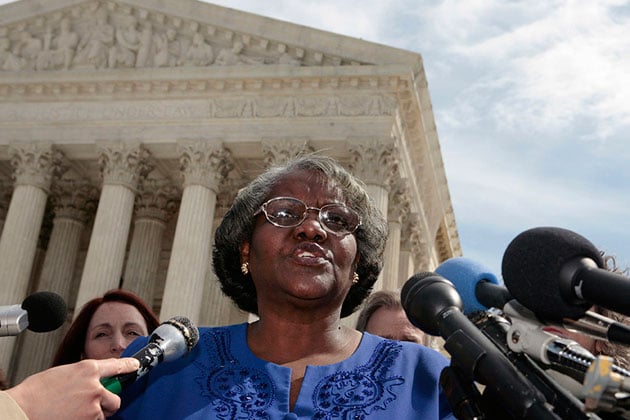
The post is shared from probulica.org. Betty Dukes talks to the press on the steps of the U.S. Supreme Court after the class action lawsuit Dukes v. Wal-Mart was argued before the court in Washington, March 29, 2011
Employers rejoiced. Others predicted serious setbacks for women and minorities, especially in employment discrimination cases brought under Title VII of the Civil Rights Act of 1964. That landmark law had opened the way to the use of the class-action lawsuit as a potent weapon for people who could not stand up for their rights on their own. Two years later, it’s becoming clear just how much the ruling has reshaped the American legal landscape. The Dukes decision has already been cited more than 1,200 times in rulings by federal and state courts, a figure seen by experts as remarkable. Jury verdicts have been overturned, settlements thrown out, and class actions rejected or decertified, in many instances undoing years of litigation. The rulings have come in every part of the country, in lawsuits involving all types of companies,... |
Related articles
- Employee Rights Hurt by Supreme Court Decisions (workers-compensation.blogspot.com)
- Why Overturning DOMA Is a Win for Employee Rights (workers-compensation.blogspot.com)
- Canada court allows disabled veteran class action to continue (workers-compensation.blogspot.com)
- Parma considering following Cleveland in suing Ohio Bureau of Workers' Compensation over inflated premiums (workers-compensation.blogspot.com)
- How Wal-Mart keeps wages low (workers-compensation.blogspot.com)
- On Access and Accountability - Two Supreme Court Rulings on Generic Drugs (workers-compensation.blogspot.com)
ARE YOU OVEREXPOSING YOURSELF IN SOCIAL MEDIA?
Today's post comes from guest author Laurel Anderson, from Causey Law Firm.
By Laurel Anderson from Causey Law Firm
Facebook, Twitter, YouTube, LinkedIn, Pinterest, Instagram and other wildly popular social media websites have transformed how people both connect with each other and obtain information about other people. It has also created a change in the legal arena. For our clients who are currently applying for or receiving workers’ comp time loss benefits, or Social Security Disability Insurance (SSDI) benefits, our advice is to keep in mind the importance of privacy settings for both written information and photos on their individual accounts. While a Washington State law went into effect this weekend barring employers from requesting access to Facebook passwords, if your privacy settings are not tight, curious parties can randomly obtain information about you.
While a Washington State law went into effect this weekend barring employers from requesting access to Facebook passwords, if your privacy settings are not tight, curious parties can randomly obtain information about you.
From our experience, you can now assume that claims managers, employers, and defense attorneys will search for information on the internet regarding your personal life that can impact your claim for benefits. Please make sure that any outdated information regarding your activities is removed from your personal page. Do not use social media to vent about your employer or state agencies that are the decision-makers in your claim. You may be under the impression that only your friends can see your personal page, and that you have some right to privacy. However, be aware that all of the content on your walls, including photos and instant messaging, could be potentially discoverable by your employer or opposing counsel in a litigated case if the content is relevant to your claim for benefits.
The risk is somewhat less in the SSDI arena since there actually is an agency directive to ALJs and DDS adjudicators that they are not to use social media to research claimants. We nevertheless warn our SSDI clients concerning social media, as we are not convinced that agency people are always playing by the rules, or that those rules may not soon change.
Photo credit: lindes / Foter / CC BY-NC-SA
Related articles
- Listen to the GAO Podcast: Social Security Administration Improper Disability Insurance Payments (workers-compensation.blogspot.com)
- Media Portrays Social Security as an Avenue to Benefits for the Unemployed - WRONG! It's Not That Simple... (workers-compensation.blogspot.com)
- What is the Date Last Insured, and Why Does it Matter? (workers-compensation.blogspot.com)
- The High Price of Gas - Mileage Reimbursement for Injured Workers (workers-compensation.blogspot.com)
- To Promote Wellness, Public Health Departments Are Launching Apps. Will They Work? (workers-compensation.blogspot.com)
- Worker Privacy Concerns : Employers' Access to Employees' Prior Worker's Compensation Claims (workers-compensation.blogspot.com)
Antibiotic Resistant Threats in the US, 2013
Healthcare workers have something to worry about. Today's post is shared from the US CDC.
Threat Report 2013
This report, Antibiotic resistance threats in the United States, 2013 gives a first-ever snapshot of the burden and threats posed by the antibiotic-resistant germs having the most impact on human health.
Each year in the United States, at least 2 million people become infected with bacteria that are resistant to antibiotics and at least 23,000 people die each year as a direct result of these infections. Many more people die from other conditions that were complicated by an antibiotic-resistant infection.
Antibiotic-resistant infections can happen anywhere. Data show that most happen in the general community; however, most deaths related to antibiotic resistance happen in healthcare settings such as hospitals and nursing homes.
Related articles
- CDC: Antibiotic-resistant bugs sicken 2 million a year (workers-compensation.blogspot.com)
- Cyclospora: It Is Not Over Yet - US Count at 548 Cases (workers-compensation.blogspot.com)
- Study: Healthcare-linked infections cost US $10 billion a year (workers-compensation.blogspot.com)
- Careful What You Wish For: Denying Worker's Compensation for Undocumented Workers (workers-compensation.blogspot.com)
- U.S. Sees Direct Threat in Attack at Kenya Mall (workers-compensation.blogspot.com)
Subscribe to:
Posts (Atom)