Copyright

(c) 2010-2026 Jon L Gelman, All Rights Reserved.

Tuesday, November 5, 2013

Supreme Court 2013: Court Could Cripple Unions In Major Labor Cases

Today's post was shared by Steven Greenhouse and comes from www.ibtimes.com

Over the next few months, the Supreme Court will hear two major cases that could prove a major setback to unions' ability to organize and collect dues -- and the conservative majority on the court is making pro-labor advocates nervous.
In UNITE HERE Local 355 v. Mulhall, the court will decide whether agreements between unions and employers that set the ground rules for union organizing violate the anti-corruption provision of the Labor Management Relations Act. That may sound pretty specific, but it could have far-reaching effects, leading labor expert and Harvard Law School professor Benjamin Sachs to write that this “could be the most significant labor law case in a generation.”
In this particular case, the union, Unite Here Local 355, struck an agreement with Mardi Gras, a Florida casino company, under which the casino would not interfere in the union’s organizing drive, and in return, the union promised not to strike during that organizing period. That kind of agreement is standard practice across the country.
The challenge to this routine agreement alleges that the casino’s concessions to the union, which included a promise to remain neutral during the organizing campaign, violates an anti-corruption statute that was intended to keep employers from bribing unions by specifically prohibiting companies from giving union officials “things of value.” Until very recently, no one considered that these organizing agreements would constitute...
[Click here to see the rest of this post]

Calling America: Hello? Hello? Hello? Hello?

Today's post was shared by Steven Greenhouse and comes from www.nytimes.com

SINGAPORE — HAVING lived and worked abroad for many years, I’m sensitive to the changing ways that foreigners look at America. Over the years, I’ve seen an America that was respected, hated, feared and loved. But traveling around China and Singapore last week, I was confronted repeatedly with an attitude toward America that I’ve never heard before: “What’s up with you guys?”
Whether we were feared or loved, America was always the outsized standard by which all others were compared. What we built and what we dreamt were, to many, the definition of the future. Well, today, to many people, we look like the definition of a drunken driver — like a lifelong mentor who has gone on a binge and is no longer predictable. And, as for defining the future, the country that showed the world how to pull together to put a man on the moon and defeat Nazism and Communism, today broadcasts a politics dominated by three phrases: “You can’t do that,” “It’s off the table” and “The president didn’t know.” A Singaporean official who has been going to America for decades expressed shock to me at being in Washington during the government shutdown and how old and emotionally depressed the city felt.
“Few Americans are aware of how much America has lost in this recent episode of bringing the American economy to the edge of a cliff,” said Kishore Mahbubani, the dean of the Lee Kuan Yew...
[Click here to see the rest of this post]

Johnson & Johnson to Pay More Than $2.2 Billion to Resolve Criminal and Civil Investigatio

Today's post is shared from justice.gov

Allegations Include Off-label Marketing and Kickbacks to Doctors and Pharmacists\Global health care giant Johnson & Johnson (J&J) and its subsidiaries will pay more than $2.2 billion to resolve criminal and civil liability arising from allegations relating to the prescription drugs Risperdal, Invega and Natrecor, including promotion for uses not approved as safe and effective by the Food and Drug Administration (FDA) and payment of kickbacks to physicians and to the nation’s largest long-term care pharmacy provider. The global resolution is one of the largest health care fraud settlements in U.S. history, including criminal fines and forfeiture totaling $485 million and civil settlements with the federal government and states totaling $1.72 billion.

“The conduct at issue in this case jeopardized the health and safety of patients and damaged the public trust,” said Attorney General Eric Holder. “This multibillion-dollar resolution demonstrates the Justice Department’s firm commitment to preventing and combating all forms of health care fraud. And it proves our determination to hold accountable any corporation that breaks the law and enriches its bottom line at the expense of the American people.”

The resolution includes criminal fines and forfeiture for violations of the law and civil settlements based on the False Claims Act arising out of multiple investigations of the company and its subsidiaries.

Monday, November 4, 2013

Truck driver was looking at phone in deadly crash

Distracted driving continues to be a constant cause of accidents in the workplace. Workers' compensation laws and policies have not been modified to encourage the non-use of cellphones. Federal legislation on the other hand outlaws their use. Today's post is shared from azcentral.com

The semi-truck that crashed into several police and fire vehicles, killing an Arizona Department of Public Safety officer in early May, was “tossing cars around like they were toys,” according to one witness statement.
Officer Tim Huffman, 47, was killed on May 6 while investigating an earlier crash on Interstate 8, about 40 miles east of Yuma. An 18-wheeler driven by Jorge Espinoza, 33, had plowed into Huffman’s patrol car and several other vehicles at about 5 p.m.
Espinoza, who faces 20 felony charges including second-degree murder, was on his cell phone at the time of the collision, according to 600 pages of case files obtained by The Arizona Republic on Friday.
The documents and a video from an in-dash camera revealed that Espinoza was on Facebook looking at pictures of provocatively dressed women at the time of the wreck.
Espinoza, who pleaded not guilty in June, told police he was looking over his shoulder at a passing truck when suddenly he felt the violent jolt from the crash. Espinoza was not injured.
He told police he never saw the multiple DPS and fire department vehicles on the roadway, or an officer frantically waving his arms trying to get his attention before he jumped out of the way.

Roche to Pay Up to $548 Million for Antibiotic Against Superbug

Pharmaceutical costs are a major portion of the medical benefit delivery dollar. The economic costs for development and production are enormous for new pharmaceuticals. Government investment in costs of treatments as well as cures is essential. Today's post shared from businessweek.com reflects on the enormity of pharmaceutical costs.

Roche Holding AG (ROG) agreed to pay as much as 500 million Swiss francs ($548 million) for the rights to an experimental antibiotic to target a drug-resistant“superbug” that is a leading cause of fatal bacterial infections in hospitals.

Polyphor Ltd., the Allschwil, Switzerland-based developer of the antibiotic, will receive 35 million francs up front, and is eligible for further payments of as much as 465 million francs if the product meets development, regulatory and commercial goals, Roche said in an e-mailed statement today.Roche also will pay royalties on sales, the Basel, Switzerland-based company said.

The treatment, known as POL7080, targets Pseudomonas Aeruginosa, a bacterium that causes one in 10 hospital-acquired infections in the U.S., according to figures from the U.S.Centers for Disease Control and Prevention cited by Roche.Bacteria increasingly are growing resistant to antibiotics,leading to 25,000 deaths a year in the European Union alone,according to EU statistics.

“As the incidence of drug-resistant infections is creating an urgent demand for new therapeutic options, we look forward to adding this potentially important, targeted agent with a novel mechanism of action to our portfolio of innovative medicines,”said Janet Hammond, a Roche executive who oversees discovery of drugs for infectious diseases.

Polyphor, a closely held company, also is developing drugs for use in stem cell transplantation and lung diseases.

[Click here to see the rest of this post]

The End of the Class-Action Carnival

The End of the Class-Action Carnival
Class actions have been a major vehicle to creating safer workplace in the past. It is imperative that the people have their day in court to maintain a democratically balanced system of  government. Today's post article is shared from businessweek.com.

F. Paul Bland Jr. brings class-action lawsuits for a living. Over the years he’s represented groups of plaintiffs in suits against payday lender Check ’n Go and financial institution Wachovia.

He’s worried about business drying up. As a result of hostile Supreme Court rulings over the last several years, scores of mass consumer and employment suits that would have been viable a decade ago have been dismissed, says Bland, a senior attorney with Public Justice, a nonprofit in Washington.

“People bring me cases against cable companies or big employers, and I say, ‘Forget it. It’s impossible. Not even worth trying.’ ”

The mass lawsuit—in which hundreds or even thousands of plaintiffs join together to go after a corporate defendant—is in deep trouble. Growing judicial skepticism toward such suits and toward the lucrative settlements they generate has caused plaintiffs’ attorneys to shy away from accepting lengthy, complicated cases.

That’s tilting the legal playing field decisively in favor of Big Business—and as the Supreme Court reconvened on Oct. 7 for its 2013-14 term, trial lawyers are bracing for more setbacks.
Not everyone is shedding tears. Walter Olson, a legal expert at the libertarian Cato Institute in Washington, attributes the decline of mass lawsuits to a predictable—and...

[Click here to see the rest of this post]

Sunday, November 3, 2013

Stable Jobs = Healthier Lives

Today's post was shared by RWJF PublicHealth and comes from www.rwjf.org

The NewPublicHealth National Prevention Strategy series is underway, including interviews with Cabinet Secretaries and their National Prevention Council designees, exploring the impact of jobs, transportation and more on health. “Stable Jobs = Healthier Lives” tells a visual story on the role of employment in the health of our communities.
Some highlights:
  • Since 1977, the life expectancy of male workers retiring at age 65 has risen 6 years in the top half of the income distribution, but only 1.3 years in the bottom half.
  • 12.3 million Americans were unemployed as of October 2012.
  • Laid-off workers are 54% more likely to have fair or poor health, and 83% more likely to develop a stress-releated health condition.
  • There are nearly 3 million nonfatal workplace injuries each year.
  • The United States is one of the few developed nations without universal paid sick days.
Also check out our previous infographics exploring the connection between transportation and health, and education and health.
For more on employment and health, read a related issue brief.View the full infographic below.
[Click here to see the rest of this post]

Why Texting-While-Driving Bans Don't Work

Today's post was shared by Mother Jones and comes from www.motherjones.com


Lost in the clamor for stricter distracted-driving laws, a study from April 2013 found discouraging patterns in the relationship between texting bans and traffic fatalities.
As one might expect, single occupant vehicle crashes dip noticeably when a state legislature enacts a texting and driving ban. But the change is always short-lived, according to this study, which examined data from every state except Alaska from 2007 through 2010. Within months, the accident rate typically returned to pre-ban levels.
The researchers, Rahi Abouk and Scott Adams of University of Wisconsin-Milwaukee, attribute this pattern to the "announcement effect," when drivers adjust their behavior to compensate for a perceived law enforcement threat—only to return to old habits when enforcement appears ineffectual. In other words, drivers might dial back their texting when they hear about a ban, but after they succumb to the urge once or twice and get away with it, they determine it's okay and keep doing it.
"It's different than drunk driving," Adams said. Identifying intoxicated drivers is relatively easy, "you can give somebody a breathalyzer, you can have checkpoints." But with texting, "it's really hard [for policemen] to know" if someone's been texting.
No one denies the dangers of texting while driving. In fact, 95 percent of AAA survey (PDF) respondents said texting behind the wheel was a "very" serious threat to their personal safety. But 35 percent of the same...
[Click here to see the rest of this post]

12 Attacks On Workers’ Rights That Will Make You Kinda Mad

Today's post was shared by Steven Greenhouse and comes from www.buzzfeed.com

These are just a few examples of the numerous legislative attacks on workers—both union and nonunion—that took place in 2011–2012, as documented in a new report by the Economic Policy Institute. Many of these attacks were coordinated by a corporate-funded lobbying organization called the American Legislative Exchange Council (ALEC).
More recently, working families have been fighting back. To find out how, check out “10 Ways Working Families Are ‘Kicking Ass’ for the Middle Class.”

[Click here to see the rest of this post]

A Vital Measure: Your Surgeon’s Skill

Today's post is shared from the nytimes.com
To those of us in training, the hospital was cursed. At least when it came to a certain operation.
We dreaded being asked to scrub in at these operations because we knew we would be forced to hold patient parts until our fingers went numb and arms quivered. The surgeons hunted, stabbed and slashed their way through the procedure; and whenever their knife would go a little too far, or their knot would slip, or their stitch pull, we braced ourselves for their fury…and for the inevitable extra time it would take for them to correct their errors.
The patients, many of whom had come in to the hospital walking and talking, ended up lingering for weeks afterward with infections, open wounds and other complications.
But everything changed when a new surgeon came on board. Built like a rugby player, he shocked us first with his speed, and then his results. The once unbearable day-long slog became a morning’s work; and instead of spending weeks in the hospital, his patients went home after eight days.
In the operating room, his bear paw hands turned delicate, teasing out tissues, caressing vessels and nimbly knotting thread as fine as human hair. There was not a single wasted movement; and each step blended seamlessly with the next, giving those of us who had the fortune to observe the sense that we were watching not surgery, but a well-choreographed ballet.
“It’s like you’re just standing there holding the needle or...
[Click here to see the rest of this post]

Exposures Caused by Dampness in Office Buildings, Schools, and Other Nonindustrial Buildings

Office buildings, schools, and other nonindustrial buildings may develop moisture and dampness problems from roof and window leaks, high indoor humidity, and flooding events, among other things.

For this Alert, we buildings [AIHA 2008]. This can lead to the growth of mold, fungi, and bacteria; the release of volatile organic compounds; and the breakdown ofice bn wet materials. Outdoors,molds live in the soil, on plants, and on dead or decaying matter.

There are thousands of species of molds and they can be any color. Different mold species can adapt to different moisture conditions.

Research studies have shown that exposures to building dampness and mold have been associated with respiratory symptoms, asthma, hypersensitivity pneumonitis, rhinosinusitis, bronchitis, and respiratory infections.

Individuals with asthma or hypersensitivity pneumonitis may be at risk for progression to more severe disease if the relationship between illness and exposure to the damp building is not recognized and exposures continue.

NIOSH Alert: Preventing Occupational Respiratory Disease from Exposures Caused by Dampness in Office Buildings, Schools, and Other Nonindustrial Buildings [PDF - 1.25 MB]
[Click here to see the rest of this post]

Saturday, November 2, 2013

Are Caregivers Healthier?

Today's post was shared by The New Old Age and comes from newoldage.blogs.nytimes.com


The idea that caring for a chronically ailing or disabled family member might be good for you is so startling, so counterintuitive, that it sends researchers rummaging through their data to see where they went wrong.

“There are hundreds of studies about how caregiving is stressful and bad for your health,” said David Roth. As director of the Johns Hopkins Center on Aging and Health, and someone who has spent 15 years compiling caregiving data, he has probably read most of them.

But his recent study in The American Journal of Epidemiology is the most recent to lend support to an emerging counter perspective, dubbed the “healthy caregiver hypothesis.”

Inserting a few key questions into a large national stroke study, his team was able to compare about 3,500 family caregivers older than 45 with noncaregivers of the same age, gender, education level and self-reported health. The researchers also matched caregivers and noncaregivers for cognitive status and for health behaviors like smoking and drinking — 15 variables in all. The caregivers included spouses (about 22 percent of the 3,500 followed), adult children caring for parents (about a third), and people caring for other family members.

After an average six-year follow-up, he and his colleagues found that the noncaregivers had 
significantly higher mortality rates. Nine percent of them had died, compared with 7.5 percent of caregivers, who were 18 percent less likely to die during the six-year...
[Click here to see the rest of this post]

Friday, November 1, 2013

Johns Hopkins medical unit rarely finds black lung, helping coal industry defeat miners' claims

Today's post was shared by FairWarning and comes from www.publicintegrity.org


There is an unmistakable pattern in Wheeler’s readings. The Center identified more than 1,500 cases decided since 2000 in which Wheeler read at least one X-ray; in all, he interpreted more than 3,400 films during this time.

The numbers show his opinions consistently have benefited coal companies:
  • Wheeler rated at least one X-ray as positive in less than 4 percent of cases. Subtracting the cases in which he ultimately concluded another disease was more likely, this number drops to about 2 percent.
  • In 80 percent of the X-rays he read as positive, Wheeler saw only the earliest stage of the disease. He never once found advanced or complicated black lung. Other readers, looking at the same images, saw these severe forms of the disease on more than 750 films.
  • Where other doctors saw black lung, Wheeler saw tuberculosis, histoplasmosis or a similar disease on about 34 percent of X-rays. This number shoots up in cases in which others saw complicated black lung, which is so severe it triggers automatic compensation. In such cases, Wheeler attributed the masses in miners’ lungs to these other diseases on two-thirds of X-rays.
Asked if he stood by this record, Wheeler said, “Absolutely.”

Delivering High-Quality Cancer Care: Charting a New Course for a System in Crisis

Today's post was shared by CDC Cancer and comes from iom.edu 

In the United States, approximately 14 million people have had cancer and more than 1.6 million new cases are diagnosed each year. By 2022, it is projected that there will be 18 million cancer survivors and, by 2030, cancer incidence is expected to rise to 2.3 million new diagnoses per year. However, more than a decade after the IOM first studied the quality of cancer care, the barriers to achieving excellent care for all cancer patients remain daunting. Therefore, the IOM convened a committee of experts to examine the quality of cancer care in the United States and formulate recommendations for improvement. Delivering High-Quality Cancer Care: Charting a New Course for a System in Crisis presents the committee’s findings and recommendations.


The committee concluded that the cancer care delivery system is in crisis due to a growing demand for cancer care, increasing complexity of treatment, a shrinking workforce, and rising costs. Changes across the board are urgently needed to improve the quality of cancer care. All stakeholders – including cancer care teams, patients and their families, researchers, quality metrics developers, and payers, as well as HHS, other federal agencies, and industries – must reevaluate their current roles and responsibilities in cancer care and work together to develop a higher quality cancer care delivery system. Working toward the recommendations outlined in this report, the cancer care community can improve the quality...


[Click here to see the rest of this post]


Related articles

Can better working conditions improve the performance of SMEs?

Today's post is shared from the Internal Labour Organization ilo.org

This study reviews the literature on the link between working conditions, safety and health and skills development, on the one hand, and increased productivity on the other, with a specific focus on small and medium-sized enterprises (SMEs). The writers find research evidence of an association between good workplace practices and various types of positive enterprise-level outcomes. These positive outcomes include reduced employee turnover, improved profitability and higher levels of customer satisfaction.

The literature surveyed consists in the main of studies of high-income economies and rather than unpacking the influence of different practices these studies serves to affirm that practices have best results when they are employed together. So, for example, a coherent ‘bundle of practices’ , combining good occupational safety and health and training with improved working hours and wages will generally improve productivity, innovation and employee retention. The review also finds evidence of a cause and effect, suggesting that better management practices lead to improved business outcomes rather than vice versa.

Despite all of the above, the review highlights that more research is needed. In particular, the researchers note the lack of literature analysing the complexity of the relationship between working conditions, safety and health, skills development, and firm outcomes. They also note the need for research in this area in developing and emerging...
[Click here to see the rest of this post]

OSHA releases new resources to better protect workers from hazardous chemicals

Each year in the United States, tens of thousands of workers are made sick or die from occupational exposures to the thousands of hazardous chemicals that are used in workplaces every day. The U.S. Department of Labor's Occupational Safety and Health Administration today launched two new web resources to assist companies with keeping their workers safe.

While many chemicals are suspected of being harmful, OSHA's exposure standards are out-of-date and inadequately protective for the small number of chemicals that are regulated in the workplace. The first resource OSHA has created is a toolkit to identify safer chemicals that can be used in place of more hazardous ones. This toolkit walks employers and workers step-by-step through information, methods,
tools and guidance to either eliminate hazardous chemicals or make informed substitution decisions in the workplace by finding a safer chemical, material, product or process. The toolkit is available at http://www.osha.gov/dsg/safer_chemicals/index.html.

"We know that the most efficient and effective way to protect workers from hazardous chemicals is by eliminating or replacing those chemicals with safer alternatives whenever possible," said Dr. David Michaels, assistant secretary of labor for occupational safety and health.

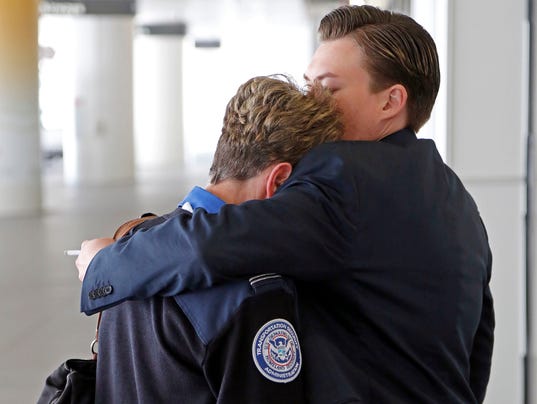
LAX shooting suspect identified; TSA agent dead

Violence in the workplace at Los Angeles Airport resulted in at least one fatality and multiple people being injured. Apparently TSA agents were targeted. TSA employees are unarmed. Today's post is shared from shared from usatoday.com

A lone gunman armed with a semi-automatic rifle went on a shooting spree Friday at Los Angeles International Airport, killing one person and leaving at least six people injured before the suspect was tracked down and taken into custody.
"We have one deceased,'' Capt. Brian Elias of the Los Angeles County Coroner's office told USA TODAY.
Tim Kauffman, a spokesman for the American Federation of Government Employees in Washington, told the Associated Press that the victim who died was a Transportation Security Administration officer. He said the union's information came from its local officials in Los Angeles.
Law enforcement officials identified the suspect as 23-year-old Paul Ciancia.
Airport police chief Patrick Gannon said the gunman forced his way past a TSA checkpoint into the heart of LAX Terminal 3.
He said authorities believe the gunman acted alone.
Ciancia, a U.S. citizen, was shot in the face in the confrontation with police, a federal law enforcement official said. The official, who was not authorized to speak publicly, said the suspect had survived the shooting but his condition was not immediately known.
One TSA officer is the only person confirmed dead, the official said.
Gannon said the shooting began at 9:20 a.m. PT, when the suspect pulled an "assault rifle" out of a bag and began to open fire in LAX Terminal 3.
"He proceeded up to...
[Click here to see the rest of this post]

California state Sen. Ron Calderon accepted $88,000 in bribes, FBI affidavit alleges

California workers' compensation scandal headlines the news over medical treatment bribes.  Today's post is shared from sacbee.com

State Sen. Ron Calderon accepted about $88,000 in bribes from an undercover FBI agent posing as a film studio owner and a Southern California hospital executive during a wide-ranging probe into his conduct as a legislator, according to a 124-page affidavit published online Wednesday by cable news network Al Jazeera America.
No charges have been filed against Calderon, a Democrat from Montebello. His attorney, Mark Geragos, did not return calls Wednesday.
The federal affidavit, filed with the court under seal as the FBI sought a search warrant for Calderon’s office, alleges that he worked with interest groups in a pay-to-play fashion, accepting money in exchange for promises to carry or amend legislation to their benefit.
GBHSQ753.3It details an arrangement to funnel money for the Calderon family’s later use through a nonprofit organization run by his brother Tom Calderon. It describes an instance in which Calderon hired a female undercover agent as a staff member as a favor to another undercover agent despite her apparent lack of qualifications for the job. It says that as Calderon steered legislation, he asked those he thought would benefit to secure jobs for his children, Jessica and Zachary.
“One way you could be a real help to (my daughter) is, you got any work?” Calderon said to an undercover agent posing as the film studio owner during a June 2012 dinner in Pico Rivera, according to the affidavit.
“I told you, man, anything...
[Click here to see the rest of this post]

As Robot-Assisted Surgery Expands, Are Patients And Providers Getting Enough Information?

Today's post is shared from kaiserhealthnews.org.

The use of robotic surgical systems is expanding rapidly, but hospitals, patients and regulators may not be getting enough information to determine whether the high tech approach is worth its cost.

Problems resulting from surgery using robotic equipment—including deaths—have been reported late, inaccurately or not at all to the Food and Drug Administration, according to one study.
The study, published in the Journal for Healthcare Quality earlier this year, focused on incidents involving Intuitive Surgical’s da Vinci Robotic Surgical System over nearly 12 years, scrubbing through several data bases to find troubled outcomes. Researchers found 245 incidents reported to the FDA, including 71 deaths and 174 nonfatal injuries. But they also found eight cases in which reporting fell short, including five cases in which no FDA report was filed at all.

The FDA assesses and approves products based on reported device-related complications. If a medical device malfunctions, hospitals are required to report the incident to the manufacturer, which then reports it to the agency. The FDA, in turn, creates a report for its Manufacturer and User Facility Device Experience database.

The use of surgical robots has grown rapidly since it was first approved for laparoscopic surgery (a type of surgery that uses smaller incisions than in traditional surgery) by the FDA in 2000. Between 2007 and 2011 the number of da Vinci systems installed increased by 75 percent in the United...
[Click here to see the rest of this post]