| Federal and state environmental agents have interviewed the former city engineer and his assistant about the city's handling of two demolition projects involving asbestos, a person with knowledge of the matter said. The emergency razing of 4-6-8-10 King St. in August 2013 and the tearing down of buildings at the King Fuels site in South Troy this year have drawn the attention of criminal investigators from the U.S. Environmental Protection Agency and the state Department of Environmental Conservation. The agents asked Russ Reeves, the former city engineer, and Barbara Tozzi, a former city engineering assistant, about the circumstances of the work and the handling of asbestos, the person, who wished to remain anonymous, said. The agents also queried Reeves regarding the nature of relationships at city hall and the involvement of individuals in the projects. Stop-work orders were issued for both demolition projects by the state because of concerns about procedures for dealing with asbestos in the 19th-century structures. The questions were similar to those asked by the FBI when one of its agents interviewed Reeves earlier this year. The state Labor Department also has investigated the asbestos removal. The city's request for proposals for the development of the Scolite site on the Hudson River in South Troy also was discussed in the latest interview, the person said. Reeves resigned as city engineer, saying that city officials were not concerned about public safety when the... |
Copyright
(c) 2010-2026 Jon L Gelman, All Rights Reserved.
Tuesday, July 22, 2014
U.S., state officials ask about asbestos
Today's post is shared from timesunion.com/
[Click here to see the rest of this post]

Mechanic can sue Ford for further damages in asbestos case
| The state Supreme Court on Wednesday allowed a former Bay Area service station owner to seek additional damages from Ford Motor Co. for exposing him to brake-lining asbestos that has afflicted him with terminal cancer. A jury awarded Patrick Scott $1.5 million in damages and legal costs against Ford in November 2012. Wednesday's order allows him to ask another jury for punitive damages. Scott and his wife, Sharon, have settled claims against other automakers for undisclosed amounts. Scott worked in a Navy shipyard, where he was also exposed to asbestos, before opening his first service station in Sausalito in 1965. He leased an Atlantic Richfield station in San Francisco in 1970, then moved his business to a Beacon station in St. Helena in 1977. He stopped working in 2011 after being diagnosed with mesothelioma, an incurable form of lung cancer that is caused by asbestos but typically does not show up until decades after exposure. Asbestos has long been used in the linings of motor vehicle brakes and clutches and is still used in brake pads, though it is banned in some other products. Scientists had established its connection to cancer by the mid-1950s, but the federal government did not regulate workplace asbestos exposure until 1971. According to court records, Ford mentioned asbestos in one of its publications in 1975 but did not put warnings on brake cartons until at least 1980. A Ford internal investigation cited by Scott's lawyers found mesothelioma among company... |
Related articles
Asbestos Disease Remains a Problem Despite Lower Consumption in the US
Cancer victims win $190 million in asbestos case
Deadly Asbestos Exposure Threat Left by Hurricane Sandy
Corporate Conspiracy: Has Anything Really Changed?
National Asbestos Awareness Week - April 1 to 7 2012
$2 Million Verdict to Plastic Compounder Suffering Mesothelioma - Call For Asbestos Ban
Monday, July 21, 2014
Part-Time Schedules, Full-Time Headaches
| A worker at an apparel store at Woodbury Common, an outlet mall north of New York City, said that even though some part-time employees clamored for more hours, the store had hired more part-timers and cut many workers’ hours to 10 a week from 20. As soon as a nurse in Illinois arrived for her scheduled 3-to-11 p.m. shift one Christmas Day, hospital officials told her to go home because the patient “census” was low. They also ordered her to remain on call for the next four hours — all unpaid. An employee at a specialty store in California said his 25-hour-a-week job with wildly fluctuating hours wasn’t enough to live on. But when he asked the store to schedule him between 9 a.m. and 2 p.m. so he could find a second job, the store cut him to 12 hours a week. These are among the experiences related by New York Times readers in more than 440 responses to an article published in Wednesday’s paper about a fledgling movement in which some states and cities are seeking to limit the harshest effects of increasingly unpredictable and on-call work schedules. Many readers voiced dismay with the volatility of Americans’ work schedules and the inability of many part-timers to cobble together enough hours to support their families. In a comment that was the most highly recommended by others — 307 of them — a reader going by “pedigrees” wrote that workers were often reviled for not working hard enough or not being educated... |
Justices Find NLRB Recess Appointments Invalid
Today's post was shared by WSJ Law Blog and comes from blogs.wsj.com
President Barack Obama exceeded his authority in appointing three National Labor Relations Board members during a brief Senate break in 2012, the Supreme Court ruled on Thursday, holding that presidents may only exercise their appointment powers during recesses of 10 or more days. WSJ’s Jess Bravin and Melanie Trottman have a break down of the decision: The decision provides a narrow win for employers who contested the validity of labor board rulings made by the recess appointees. But by a 5-4 vote, the court refused to virtually eliminate the president’s power to fill vacancies when the Senate wasn’t transacting business, as a lower court had done.The case came from a labor dispute involving a Pepsi bottler in Washington State, the Noel Canning unit of Noel Corp., which contested a National Labor Relations Board ruling that it had unlawfully refused execute a collective bargaining agreement with a labor... |
Related articles
Supreme Court case highlights U.S. labor agency political divide
Preparing For US Supreme Court Health Care Decision Day
US Supreme Court Rules State Mesothelioma Claim Preempted By Federal Locomotive Statute
College Football Players Get Approval to Unionize - Workers Compensation Next
A Step Toward Justice in College Sports?
NJ COLA Bill is passed by the State Senate
Sunday, July 20, 2014
Employment Status An Issue: Who's their real boss
| Today's post is shared from http://www.mercurynews.com Who's your boss? For an increasing number of American workers, it's a hard question to answer. To cut costs and avoid liability, more companies are hiring workers on a temporary or contract basis. More than 17 million people, 12 percent of the U.S. workforce, are now employed as temps, contract or freelance workers. If you're a temp, which company is responsible for your pay, your schedule — and your right to a safe workplace? The agency that hired you, or the company that hired the agency? The right answer, according to a group of temporary workers at a recycling plant in Milpitas, is both. They get paid by one company — Leadpoint Business Services — but work under the direction of a different one — Browning Ferris Industries (BFI), which operates the facility. When temps at Milpitas filed a union organizing petition last year, they asked the National Labor Relations Board to recognize both Leadpoint and BFI as joint employers. Seeking representation by the Teamsters, the workers argued that since two companies share control over the work environment, both should come to the bargaining table. The regional office of the NLRB disagreed, finding Leadpoint alone was the employer. The temporary workers have appealed. My organization — the National Council for Occupational Safety and Health — recently joined an amicus brief in support of their claim that both companies are joint... |
Related articles
- Equal Work, Less-Equal Perks; Microsoft Leads the Way in Filling Jobs With 'Permatemps' (workers-compensation.blogspot.com)
- BBC reports poor working conditions in Amazon warehouses (workers-compensation.blogspot.com)
- Case Remanded to Compensation Court to Determine Employment Status (workers-compensation.blogspot.com)
- The Vanishing Concept of a Job (workers-compensation.blogspot.com)
- Temporary Work, Lasting Harm (workers-compensation.blogspot.com)
- Careful What You Wish For: Denying Worker's Compensation for Undocumented Workers (workers-compensation.blogspot.com)
- McDonald's Canada: A Guest Worker Program Under Scrutiny (workers-compensation.blogspot.com)
CCWC at Disneyland
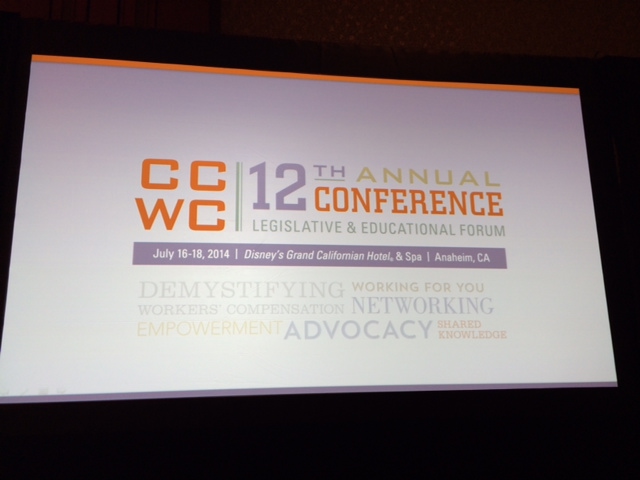
Today's post is authored by Julius Young and shared from workcompzone.com I’ve been attending the 2014 California Coalition on Workers’ Compensation annual conference at Disneyland, which wrapped up yesterday. On Wednesday the conference kicked off with a blogger’s panel featuring myself, insurance consultant and blogger Peter Rousmaniere, Workcompcentral.com publisher David DePaolo, and WorkersCompensation.com publisher Bob Wilson. Mark Walls of Safety National Insurance moderated a lively discussion that got into some “out of the box” discussions about the direction of workers’ comp; in a coming post I’ll reprise some of the thoughts from the panel and offer some further insights. CCWC is a major player on the California workers’ comp scene. Many of California’s big employers are members. I’m talking companies like Safeway, Walt Disney and UPS. CCWC is one of several prominent employer advocates in Sacramento along with the Cal Chamber and groups like WCAN (Workers Compensation Action Network). Members of CCWC were pivotal in drafting and pushing through the 2012 SB 863 California comp reforms. Key board members clearly have the ear of Brown Administration policymakers. And the Sacramento lobbyists used by CCWC, Paul Yoder and Jason Schmelzer, are a talented bunch. In short, the conference attracts many of the key employer and insurer players in California workers’ comp. Here are some of the more interesting things I heard and some of my random impressions from the... |
Related articles
- It's A Priviledge (workers-compensation.blogspot.com)
- Legal Fees and Reform (workers-compensation.blogspot.com)
- Work Comp Lost Focus (workers-compensation.blogspot.com)
- Top 10 Events in California Workers' Comp 1st Half 2014 (workers-compensation.blogspot.com)
- AIG Exits Workers Compensation As Comp Medical Issues Grow (workers-compensation.blogspot.com)
- California limits workers' comp sports injury claims (workers-compensation.blogspot.com)
Using Mobile Technology for Work Linked to Higher Stress
Heavier users carry more stress, but also rate lives betterby Dan Witters and Diana LiuThis article is part of a weeklong series analyzing how mobile technology is affecting politics, business, and well-being. WASHINGTON, D.C. -- U.S. workers who email for work and who spend more hours working remotely outside of normal working hours are more likely to experience a substantial amount of stress on any given day than workers who do not exhibit these behaviors. Nearly half of workers who "frequently" email for work outside of normal working hours report experiencing stress "a lot of the day yesterday," compared with the 36% experiencing stress who never email for work. Time spent working remotely outside of working hours aligns similarly, with 47% of those who report working remotely at least seven hours per week having a lot of stress the previous day compared with 37% experiencing stress who reported no remote work time. These data were collected from March 24 through April 10, 2014, as part of the Gallup-Healthways Well-Being Index for a special Gallup study exploring the effects of mobile technology on politics, business, and well-being in the United States. Gallup interviewed 4,475 working U.S. adults, and the findings hold true after controlling for age, gender, income, education, race/ethnicity, region, marital status, and children in household. Workers Who Use Mobile Technology Rate Their Lives... |
Related articles
- ExxonMobil Knew for Years About Defects in Ill-Fated Arkansas Pipeline (workers-compensation.blogspot.com)
- OSHA Warns Workers About Cold Stree (workers-compensation.blogspot.com)
- Senate fails to revive workers' comp bill for first responders (workers-compensation.blogspot.com)
- BBC reports poor working conditions in Amazon warehouses (workers-compensation.blogspot.com)
- Overwork A Recognized Compensable Condition (workers-compensation.blogspot.com)
- The Age-Old Question: Which Workers Have the Greatest Risk for Hand Injuries? (workers-compensation.blogspot.com)
European Parliament pilot project on health and safety of older workers
![]() The project, Safer and healthier work at any age – occupational safety and health (OSH) in the context of an ageing workforce aims to assess the prerequisites for OSH strategies and systems to take account of an ageing workforce and ensure better prevention for all throughout working life. The results will assist policy development and provide examples of successful and innovative practices. In doing so, the work aims to highlight what works well, what needs to be done or prioritised and to identify the main drivers and obstacles to effective implementation of policy initiatives in this area. The project builds on existing European work on sustainable work, for example, that of Eurofound. The project is investigating:
|
Related articles
- Why older workers are still wanted in the office (workers-compensation.blogspot.com)
- Examining the Reality of Workers' Memorial Day (workers-compensation.blogspot.com)
- Safety Violations Matter: Wisconsin Court Reaffirms Basis for Employer Safety Penalties (workers-compensation.blogspot.com)
- What is Total Worker Health™? (workers-compensation.blogspot.com)
- The Vanishing Concept of a Job (workers-compensation.blogspot.com)
- 1st International Symposium to Advance TOTAL WORKER HEALTH™ (workers-compensation.blogspot.com)
Port of Seattle, Eagle Marine Agree to Make Terminal 5 Big Ship Ready
Today's post is shared from Kit Case of Causey Law (Longshore Law Firm) of Seattle Washington.
The Port of Seattle and Eagle Marine Services (EMS), operator of Terminal 5, announced on May
16th a proposal to relocate its cargo and breakbulk activities to another terminal so that the port can modernize Terminal 5 to handle the bigger ships that are changing international shipping.
“If we’re going to keep jobs in Washington state, we need investments that make us globally competitive,” said Port of Seattle Commissioner Bill Bryant. “That’s why we’re rebuilding T5. We’re investing in jobs. Modernizing T5 so it can handle the new big ships is the first step in realigning our port for the future.”
“As we are working to preserve maritime jobs in Seattle, the Commission is moving forward to strengthen cooperation with the Port of Tacoma to increase trade in Puget Sound,” said Port of Seattle Commissioner John Creighton. “We’re having productive talks on how we can make the Puget Sound gateway more competitive and create new jobs.”
“ILWU Local 19 appreciates the work the Port of Seattle and terminal operators are doing to keep cargo here in Seattle by making each of our terminals big ship ready,” said ILWU Local 19 President Cam Williams. “By preparing for the future, we insure that jobs will stay in the region.”
Shipping lines are consolidating into new alliances, and have been launching much bigger ships as part of their strategy to reduce costs. While three of the port’s container terminals are already home to Super Post-Panamax cranes that service 10,000 TEU vessels and above, the existing cranes at Terminal 5 are not able to handle these bigger ships.
Under the proposal, EMS would shift its operations to Terminal 18, allowing EMS to preserve container volume and ship calls. This commitment will preserve maritime jobs that depend on cargo flowing today through T5. Cargo destined to T5, under this proposal, would begin transitioning to T18 in mid-June. The proposal with EMS is tentative pending approval by the Port of Seattle Commission.
“T5 needs to be modernized for the bigger ships that are already here, we applaud the Port in working with us to preserve our customers’ cargo through this gateway,” said Nathaniel Seeds, COO of Eagle Marine Services, Ltd.
Maintaining efficient cargo throughput is essential for moving goods in and out of the port. With four in ten jobs in Washington dependent on trade, these terminal improvements will insure that Washington goods can get out of the Port of Seattle and into markets world-wide.
“Preserving vessel service capacity is good for exporters, we appreciate the Port of Seattle’s efforts to keep this gateway competitive,” said Anderson Hay CEO & President Mark Anderson.
The Port has also received approval from the federal government to let the U.S. Army Corps of Engineers begin studying the potential for a project that may result in the deepening of the West Waterway channel near the terminal.
![]() |
| Kit Case |
“If we’re going to keep jobs in Washington state, we need investments that make us globally competitive,” said Port of Seattle Commissioner Bill Bryant. “That’s why we’re rebuilding T5. We’re investing in jobs. Modernizing T5 so it can handle the new big ships is the first step in realigning our port for the future.”
“As we are working to preserve maritime jobs in Seattle, the Commission is moving forward to strengthen cooperation with the Port of Tacoma to increase trade in Puget Sound,” said Port of Seattle Commissioner John Creighton. “We’re having productive talks on how we can make the Puget Sound gateway more competitive and create new jobs.”
“ILWU Local 19 appreciates the work the Port of Seattle and terminal operators are doing to keep cargo here in Seattle by making each of our terminals big ship ready,” said ILWU Local 19 President Cam Williams. “By preparing for the future, we insure that jobs will stay in the region.”
Shipping lines are consolidating into new alliances, and have been launching much bigger ships as part of their strategy to reduce costs. While three of the port’s container terminals are already home to Super Post-Panamax cranes that service 10,000 TEU vessels and above, the existing cranes at Terminal 5 are not able to handle these bigger ships.
Under the proposal, EMS would shift its operations to Terminal 18, allowing EMS to preserve container volume and ship calls. This commitment will preserve maritime jobs that depend on cargo flowing today through T5. Cargo destined to T5, under this proposal, would begin transitioning to T18 in mid-June. The proposal with EMS is tentative pending approval by the Port of Seattle Commission.
“T5 needs to be modernized for the bigger ships that are already here, we applaud the Port in working with us to preserve our customers’ cargo through this gateway,” said Nathaniel Seeds, COO of Eagle Marine Services, Ltd.
Maintaining efficient cargo throughput is essential for moving goods in and out of the port. With four in ten jobs in Washington dependent on trade, these terminal improvements will insure that Washington goods can get out of the Port of Seattle and into markets world-wide.
“Preserving vessel service capacity is good for exporters, we appreciate the Port of Seattle’s efforts to keep this gateway competitive,” said Anderson Hay CEO & President Mark Anderson.
The Port has also received approval from the federal government to let the U.S. Army Corps of Engineers begin studying the potential for a project that may result in the deepening of the West Waterway channel near the terminal.
Related articles
- Is Shipping Oil by Rail As Dangerous As the Keystone Pipeline? (workers-compensation.blogspot.com)
- Ship Breaking - Unsafe Working Conditions on the Beaches of Bangladesh (workers-compensation.blogspot.com)
- Employee Rights Hurt by Supreme Court Decisions (workers-compensation.blogspot.com)
- OSHA Fines Norfolk Southern Railway $800,000 for Terminating Injured Workers (workers-compensation.blogspot.com)
- Truckers Face Roadblocks for FMLA (workers-compensation.blogspot.com)
- Employee Rights Hurt by Supreme Court Decisions (workers-compensation.blogspot.com)
Mapping the lives and deaths of workers: An emerging way to tell the story of occupational health and safety
| Today's post is shared from scienceblogs.com When Bethany Boggess first debuted her online mapping project, she didn’t expect it to attract so much attention. But within just six months of its launch, people from all over the world are sending in reports and helping her build a dynamic picture of the lives and deaths of workers. The project is called the Global Worker Watch and it’s quite literally a living map of worker fatalities and catastrophes from around the globe. When you go to the site, you’ll see a world map speckled with blue dots, each representing a reported occupational death, illness or disaster. Here are just a few I randomly clicked on: In March in Pakistan, four workers died and 18 were injured when a gas cylinder exploded at a gas company. Also in March in Gujarat, India, two workers died of silicosis, an occupational disease caused by the inhalation of silica dust. Three workers have died in the mines of Coahuila, Mexico, since January. In February, a worker at an Iron County mine site in Utah died after getting trapped on a conveyer belt. Just a few days ago, a worker in the United Kingdom died after falling from an electricity tower. And in May, police in Cambodia opened fire during a labor protest, killing four people. “Obviously, I’m only capturing the tip of the iceberg,” said Boggess, a 26-year-old epidemiology student at the University of Texas School of Public Health in Austin. “But if I’m just one person and I can do this in six... |
Related articles
- Proposed Silica Standard Needs to Be Strengthened (workers-compensation.blogspot.com)
- American Thoracic Society Welcomes OSHA's Proposed Lower Silica Exposure Standard (workers-compensation.blogspot.com)
- OSHA Cites Nebraska Food Supplement Plant for 10 Violations (workers-compensation.blogspot.com)
- Midwest Center for Occupational Health and Safety (workers-compensation.blogspot.com)
- Why We're Still Killing Workers in the USA (workers-compensation.blogspot.com)
- Silica: A Long Overdue Proposal (workers-compensation.blogspot.com)
Biggest Insurer Drops Caution, Embraces Obamacare
| UnitedHealthcare, the insurance giant that largely sat out the health law’s online marketplaces’ first year, said Thursday it may sell policies through the exchanges in nearly half the states next year. “We plan to grow next year as we expand our offering to as many as two dozen state exchanges,” Stephen Hemsley, CEO of UnitedHealth Group, the insurance company’s parent, told investment analysts on a conference call. He was referring to coverage sold to individuals. The move represents a major acceleration for the company and a bet that government-subsidized insurance, sold online without regard for pre-existing illness, is here to stay. UnitedHealthcare sells individual policies through government exchanges in only four states now. Even analysts who follow the company closely seemed surprised. “You’re making a really big move,” Kevin Fischbeck, an analyst for Bank of America, told the company’s executives. “You’re going to do a couple dozen states. You’ve really moved in. What’s giving you the confidence … that it’s going to be stable next year?” The answer, the bosses said, is that the marketplaces look sustainable, even without some of the reinsurance and risk-spreading backstops put in place for carriers in the first few years. They know the prices now, they said. They know the regulations. They know how consumers are... |
Related articles
- Are Smokers Really the ACA's Biggest Losers? (workers-compensation.blogspot.com)
- 'Flurry' Of New Reports Show Wide Variations On Insurance Rate Costs (workers-compensation.blogspot.com)
- WellPoint Sees Small Employers Dropping Health Coverage (workers-compensation.blogspot.com)
- Colorado Exchange Releases Health Insurance Rates (workers-compensation.blogspot.com)
- ObamaCare's Union Favor (workers-compensation.blogspot.com)
Saturday, July 19, 2014
Medical Errors - The Third Leading Cost of Death
Costing almost $1 Trillion dollars per year and a leading of death are medical errors.
Medical doctors specializing in patient safety testified on preventable medical errors that can lead to death or serious financial problems as bills mount to correct the medical mistake.
Related articles
- Most Common Medical Malpractice Claims (And How to Avoid Being a Victim) (andresberger.com)
- Opioid Use in Workers' Compensation (workers-compensation.blogspot.com)
- Not Expanding Medicaid: Deadly Consequences (workers-compensation.blogspot.com)
- Law to Ban Medical Expense Claims Proposed (workers-compensation.blogspot.com)
- Thousands of doctors practicing despite errors, misconduct (workers-compensation.blogspot.com)
- What Impact Will Hepatitis C Drugs Have on Medical Costs? Look Here (workers-compensation.blogspot.com)
Florida jury awards $23 billion punitive damages against RJ Reynolds
| R. J. Reynolds Tobacco Company (Photo credit: Wikipedia) |
| This post is shared from reuters.com A Florida jury has awarded the widow of a chain smoker who died of lung cancer punitive damages of more than $23 billion in her lawsuit against the R.J. Reynolds Tobacco Company, the nation's second-biggest cigarette maker. The judgment, returned on Friday night, was the largest in Florida history in a wrongful death lawsuit filed by a single plaintiff, according to Ryan Julison, a spokesman for the woman's lawyer, Chris Chestnut. Cynthia Robinson of Florida Panhandle city of Pensacola sued the cigarette maker in 2008 over the death of her husband, Michael Johnson. Johnson, a hotel shuttle bus driver who died of lung cancer in 1996 at age 36, smoked one to three packs a day for more 20 years, starting at age 13, Chestnut said. "He couldn't quit. He was smoking the day he died," the lawyer told Reuters on Saturday. After a four-week trial and 11 hours of jury deliberations, the jury returned a verdict granting the widow $7.3 million and the couple's son $9.6 million in compensatory damages. The same jury deliberated for another seven hours before deciding to award Robinson the additional sum of $23.6 billion in punitive damages, according to the verdict forms. Lawyers for the tobacco company, a unit of Reynolds American Inc [RAI.N] whose brands include Camel cigarettes, could not immediately be reached for comment. But J. Jeffery Raborn, vice president and assistant general counsel for R.J. Reynolds, said in a statement quoted by the New York... |
Related articles
- Jury Awards $9 Billion in Damages in Drug Case (workers-compensation.blogspot.com)
- Fla. appeals court says $33M in damages to smoker's widow not excessive (workers-compensation.blogspot.com)
- Injured plant worker is awarded $28 million (workers-compensation.blogspot.com)
- Asbestos and Cigarettes (workers-compensation.blogspot.com)
- Deal reached on tobacco firm corrective statements (workers-compensation.blogspot.com)
Senate Briefing “Asbestos: The Impact on Public Health and the Environment” a Huge Success!!
Today's post is shared from adao.us.

On July 17, we were proud to continue the Asbestos Disease Awareness Organization‘s efforts to protect asbestos victims’ civil rights and public health by hosting our sixth Congressional Staff Briefing this time on “Asbestos: The Impact on Public Health and the Environment.” This Senate briefing was a huge success with over 60 people attending and 28 states represented.
ADAO would like to extend a big thank you to all the senators who sent staffers.
1. Alabama – Session
2. Arkansas – Pryor
3. California – Feinstein
4. California –Boxer
5. Colorado – Bennet
6. Connecticut – Blumenthal
7. Florida – Nelson
8. Georgia – Isakson
9. Idaho – Crapo
10.Illinois – Durbin
11.Indiana – Coats
12.Indiana – Donnelly
13.Iowa – Harkin
14.Kansas – Roberts
15.Kentucky – Paul
16.Louisiana – Vitter
17.Maine – King
18.Massachusetts – Markey
19.Montana – Tester
20.New Jersey – Booker
21.New Mexico – Udall
22.Ohio – Portman
23.Oklahoma – Inhofe
24.Oregon – Merkley
25.Oregon – Wyden
26.Pennsylvania – Casey
27.Rhode Island – Reed
28.South Dakota – Johnson
29.Utah – Hatch
30.Vermont – Sanders
31.Washington – Murray
The major...
[Click here to see the rest of this post]

On July 17, we were proud to continue the Asbestos Disease Awareness Organization‘s efforts to protect asbestos victims’ civil rights and public health by hosting our sixth Congressional Staff Briefing this time on “Asbestos: The Impact on Public Health and the Environment.” This Senate briefing was a huge success with over 60 people attending and 28 states represented.
ADAO would like to extend a big thank you to all the senators who sent staffers.
1. Alabama – Session
2. Arkansas – Pryor
3. California – Feinstein
4. California –Boxer
5. Colorado – Bennet
6. Connecticut – Blumenthal
7. Florida – Nelson
8. Georgia – Isakson
9. Idaho – Crapo
10.Illinois – Durbin
11.Indiana – Coats
12.Indiana – Donnelly
13.Iowa – Harkin
14.Kansas – Roberts
15.Kentucky – Paul
16.Louisiana – Vitter
17.Maine – King
18.Massachusetts – Markey
19.Montana – Tester
20.New Jersey – Booker
21.New Mexico – Udall
22.Ohio – Portman
23.Oklahoma – Inhofe
24.Oregon – Merkley
25.Oregon – Wyden
26.Pennsylvania – Casey
27.Rhode Island – Reed
28.South Dakota – Johnson
29.Utah – Hatch
30.Vermont – Sanders
31.Washington – Murray
The major...
[Click here to see the rest of this post]
Related articles
- ADAO Resource: How To Find a Doctor or Treatment Facility Specializing in Mesothelioma and Asbestos-Related Diseases (workers-compensation.blogspot.com)
- Asbestos Disease Awareness Organization New Infographic: Irrefutable Facts About Asbestos (workers-compensation.blogspot.com)
- Asbestos Awareness Conference To Focus on Public Health, Environment and The Economy (workers-compensation.blogspot.com)
- Asbestos: ADAO to Livestream the film -- Breathtaking (workers-compensation.blogspot.com)
- "Trying to Make a Living" - Rebecca's Story (workers-compensation.blogspot.com)
- ADAO Special Report "The USA Asbestos Toxic Trade Continues" (workers-compensation.blogspot.com)
Subscribe to:
Posts (Atom)


